Tecopa’s long-discussed bicycle and pedestrian corridor is poised to take its biggest formal step yet Tuesday, when the Inyo County Board of Supervisors meets in Tecopa and considers a contract that would move the project from concept into environmental review, right-of-way work and construction-ready design. The Board is scheduled to consider an agreement with Dokken Engineering of Folsom for the Connecting Tecopa: Bicycle and Pedestrian Safety Corridor in an amount not to exceed $1,538,383.23, covering phased professional services from May 15, 2026 through June 30, 2029. Those services would include environmental documentation, plans, specifications and estimates preparation, and right-of-way support, with the work still contingent on future budgets and the allocation of awarded funds.
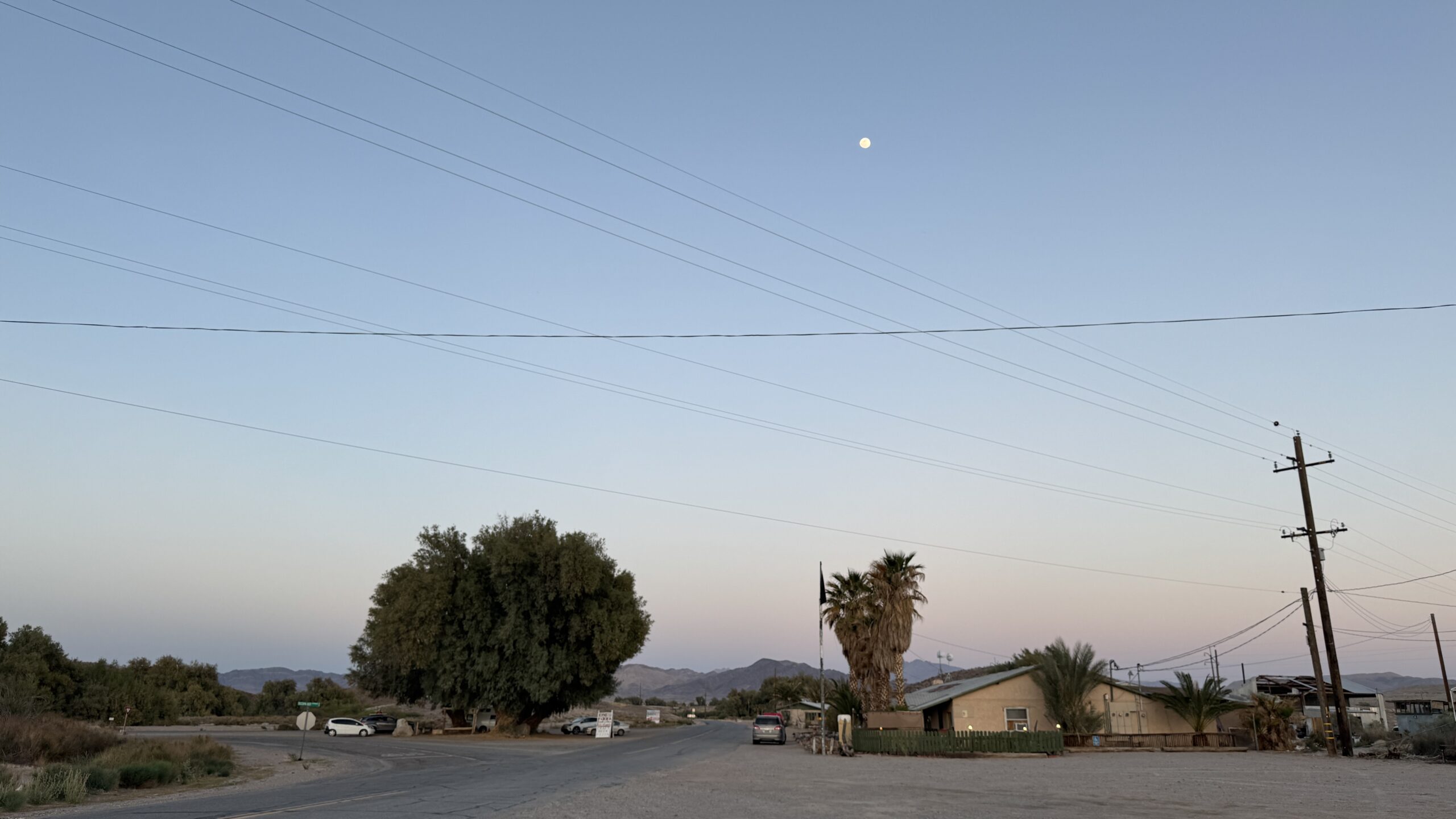
As TecopaCabana previously reported, the corridor would bring the first real pedestrian infrastructure to stretches of town that have long functioned without sidewalks, while linking key destinations through Tecopa (pictured above) and Tecopa Hot Springs. Earlier project materials described a continuous route tying together Tecopa Heights, the downtown triangle and the hot springs commercial area, with new sidewalks, a separated path, clearer crossings and traffic-calming measures intended to slow drivers through the community’s busiest segments.
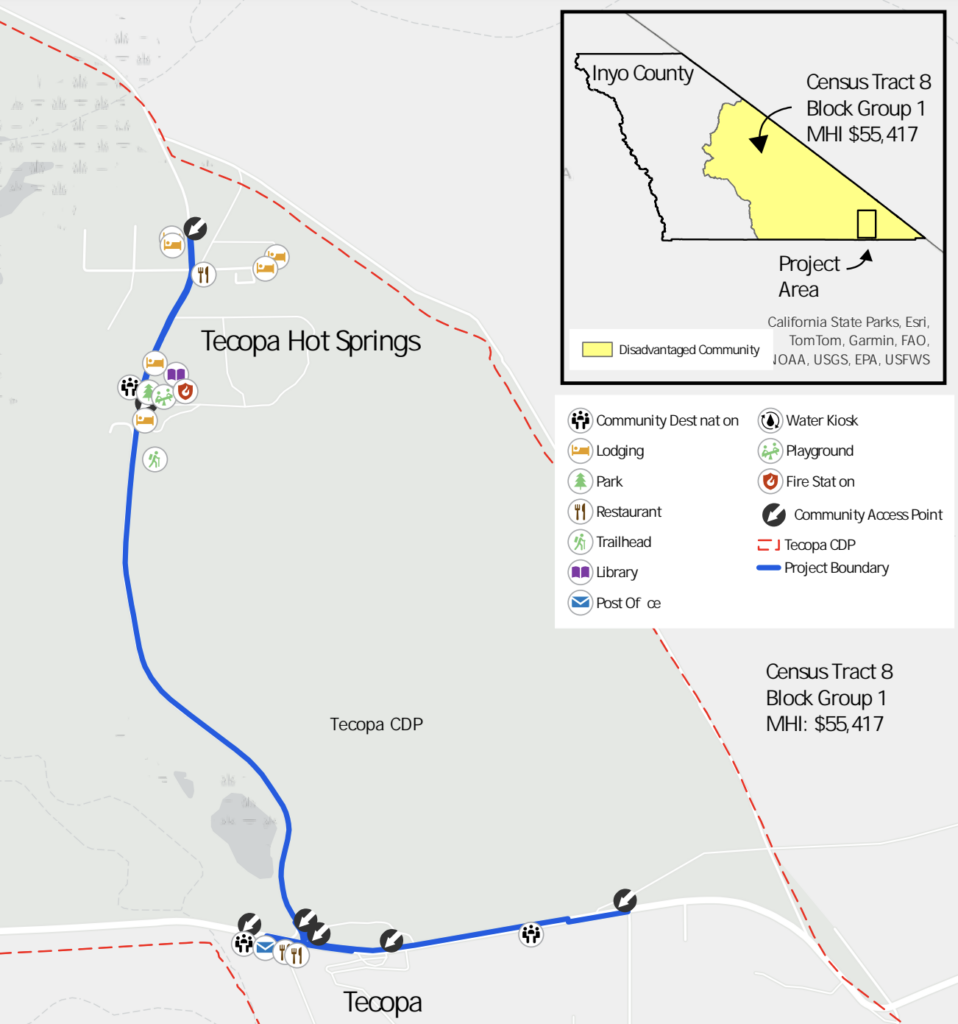
The new packet fills in more of what the next phase is meant to accomplish. According to Dokken’s proposal, the county is entering this stage with a substantial foundation already in place: active transportation planning, an ATP grant award, public workshops and surveys, documented mobility barriers, conceptual geometric layouts, and letters of support from residents, businesses, first responders and regional stakeholders. The next job is more technical and more consequential: secure CEQA and NEPA clearance, refine the concept into buildable geometry, complete any needed right-of-way acquisitions, meet ATP deadlines, and produce the final bid-ready plans.
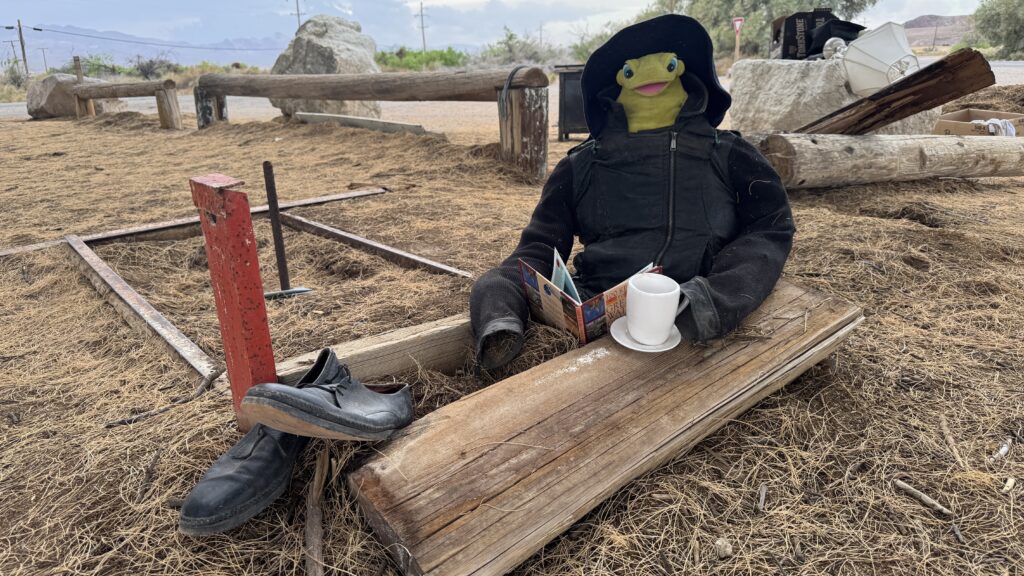
For Tecopa itself, the most revealing language in the packet centers on the Triangle intersection, long recognized as awkward and unsafe. Dokken says it will specifically address sight-distance concerns at the Triangle while trying to preserve a nearby community gathering space with four established trees. The Triangle is where the free rock functions as a quiet mutual-aid exchange: leave something, take something, no questions asked. The firm also says the design will account for the kinds of vehicles that define local road life here, including RVs and truck-and-trailer combinations, and that it intends to minimize impacts to private parcels and overhead utilities as the alignment is refined.
The county is envisioning more than a basic sidewalk project. The corridor is being treated as both a safety upgrade and a piece of community design, combining roadway changes, traffic calming, intersection improvements and gateway features into a single plan. Proposed elements include raised crosswalks, pedestrian refuge islands and visual entry markers meant to cue drivers to slow down as they enter Tecopa and Tecopa Hot Springs.
Tuesday’s meeting will take place at 2 p.m. at the Hurlbut Rook Community Center in Tecopa, with Zoom access also available. The corridor item appears on the regular agenda alongside a Southeast County workshop featuring updates from Death Valley National Park, Amargosa Conservancy, Friends of the Amargosa Basin, Southern Inyo Fire Protection District, and Community Advocates for Southeast Inyo.
Another item worth watching, though less dramatic on its face, is a consent-agenda resolution tied to CalRecycle grant programs. The packet makes clear that this is not a grant award and does not identify any specific program or dollar amount now headed to Inyo County. Instead, it is an enabling resolution: CalRecycle requires participating jurisdictions to formally authorize someone to submit grant applications and execute related documents. The proposed resolution would authorize the Assistant County Administrator to submit those applications and allow the Assistant County Administrator or a designee to execute the paperwork needed to secure and implement any resulting grants. County staff say there is no direct fiscal impact from adopting the resolution itself, but add that without it, Inyo may be unable to apply for CalRecycle opportunities at all.
That matters for a county where solid-waste, recycling and illegal-dumping issues are never far from the practical realities of desert life. But the packet stops short of saying which CalRecycle programs Inyo is targeting this round. What supervisors are being asked to approve Tuesday is essentially the administrative gatekeeping needed to keep the county eligible when those opportunities arise.
The same is true of another consent item involving the California Governor’s Office of Emergency Services. County staff say Inyo’s previous authorization expired in November 2025, and that the Board now needs to renew it so the county can continue pursuing state and federal emergency funding. The packet ties the issue directly to reimbursement on the Whitney Portal Road II culvert repair project, noting that after federal reimbursement, Cal OES is expected to cover 75% of the remaining expense, or $38,229.91. The updated authorization would also allow Inyo to pursue future disaster and resilience grants, including FEMA’s Building Resilient Infrastructure and Communities program.
Most of the remaining agenda is routine county business, including a three-year ESRI GIS renewal at $32,550 per year, a three-year behavioral health performance contract with the state, a request from the Moontribe Collective to reserve all campsites at Tinnemaha Creek Campground from June 27 to July 1, and a temporary lane closure for the Whiskey Tango Fondo cycling event on April 26.
Still, for Tecopa, the center of gravity is clearly the corridor. The project has now moved beyond broad aspiration and into the phase where the hard choices get made: how much land is needed, what must shift, what can be preserved, where traffic can be slowed, and whether Tecopa’s first real pedestrian infrastructure can be designed without losing the qualities that make the town itself feel like Tecopa. Tuesday’s vote will not put concrete in the ground. But it would move the county into the years-long design and clearance process that decides what, exactly, gets built.


Leave a Reply