Moapa Paiute vice chairman Gregory Anderson, a singer of his tribe’s mourning songs, declined to visit Queho’s grave. At the premiere of Ted Faye’s unfinished documentary, he explained why.
SHOSHONE — Gregory Anderson would not go to the grave.
Anderson is vice chairman of the Moapa Band of Paiutes and a singer of his tribe’s mourning songs. Filmmaker Ted Faye had asked him to visit the headstone in Cathedral Canyon that marks the presumed grave of Queho, the Paiute man blamed for a string of killings in the early 1900s in the river canyons south of Las Vegas. Anderson told a full house at Friday’s premiere why he declined.
“So, he asked me to go to the headstone or wherever it was,” Anderson said. “And I’m very superstitious because I sing for the spirit. And I bring the spirit to him. So, I’m superstitious about it because that’s what I do. So that’s why I said, no, I don’t want to go there.”
Anderson said Queho never received those songs. He believes Queho’s spirit is still waiting, “because he has a desire on that final turn to go across to the other side.”
The songs belong to the Salt Song Trail, the sacred song cycle of the Nuwuvi, or Southern Paiute, people, sung at memorial ceremonies. The cycle carries the singer and the spirits of the dead across ancestral homeland: desert, river valley and plateau, along the routes of the ancestors to sacred sites. Anderson said singers sing through the night after a death, then again a year later, to carry the spirit to the other side.
For Anderson, the trail begins at a single peak. “Because the songs start from Mount Charleston,” he said. “Those songs cross the river two times.”
The headstone marking Queho’s presumed grave stands in Cathedral Canyon, in the valley below that mountain.
The moment isn’t in The Strange Case of Queho, the seventh film in Faye’s Weird Tales series. It premiered Nov. 13 at the Flower Building in Shoshone and opened the weekend long Weird Tales Festival, a benefit for the Southern Inyo Fire Protection District. Admission was free, with a suggested $20 donation.
Robin Flinchum, board chair of the SIFPD, opened for the district, which covers 1,200 square miles within Inyo County, California, and asked the audience to fill the large fire boots around the room with donations. “We’re the ones who have your back on the road to nowhere, where there’s something behind you and there’s something in front of you, but it seems like there’s nothing around you. But there is. It’s us. And that’s all there is.”
A legend reexamined
Faye’s film follows the case of Queho, described as clubfooted and accused of killings between 1910 and 1919. The best-known is the January 1919 murder of Maude Douglas, a former schoolteacher who had been nursing flu patients in Eldorado Canyon. Later, two prospectors found his remains in a cave above the Colorado River in 1940. For years afterward his mummified remains was a curiosity, displayed during Las Vegas’s Helldorado celebration, before a lawyer named Roland Wiley bought the remains and arranged a burial at Cathedral Canyon. The marker, a panelist notes in the film, misspells his name and gets the dates wrong.
Faye narrates in the first person, joined by historian Mark Hall-Patton, researchers Tim and Lisa, and longtime river guides. With a set up cameo by local YouTuber Wonderhussy, the film questions the legend. Interviewees put the believable body count at about six, well short of the 20 or more often attributed to Queho.
The film argues that Eldorado Canyon, with no resident law, made Queho a convenient suspect. It cites a 1912 newspaper account that blamed half a dozen canyon murders on mine owner John Nash. “Every time a body turned up, it was simpler to blame the phantom than the man standing beside you,” Faye narrates.
Anderson’s on-screen view is shorter. Asked at the film’s end to finish the sentence “The story of Queho is,” he answered: “Bullshit.”
A premiere, not a finished film
During the question-and-answer session, Faye said the film would keep growing. “Our game plan is to do a 25 minute addendum to this, to get Tim up to the cave on another route, to include more about Cathedral Canyon, to do a ground penetrating radar, believe it or not,” he said. The goal, he added, is to “see if Queho’s bones are really there.” Whether the grave holds his remains has not been confirmed.
The artifacts originally found with his body in the cave, including two guns and a bow, are also missing. Hall-Patton said the items had been offered to museums and turned down, and later passed into private hands. “The last sighting of them was probably 35, 40 years ago,” he said.
Faye described the Queho film as his gift to the festival. “We’ll do this film,” he said, “that’ll be our contribution to the whole shootin’ match.” Before the feature, he tried to show a preview of his next project, A Sure Bet, a documentary on early Las Vegas history. “We were able to get a grant from the City of Las Vegas to produce a documentary,” he said.
The trailer began without sound. The Bluetooth audio connection failed repeatedly as several people stepped in to work through settings on the laptop. Faye joked it was “a Microsoft glitch” as per recent national headlines. Flinchum kept the room going, talking up the fire district, taking questions and introducing guests, until the sound finally connected to cheers.
As the trailer concluded, Faye turned to the audience, “I’m not going to say much about this film to get started because I’m in the dark and you can’t see me anymore. But I want you to know that we truly went on a journey with this film.”
At least one attendee walked out during the screening, calling it “the worst movie” they had ever seen. A second screening, scheduled for Saturday evening was canceled. So was a Sunday tour of Cathedral Canyon that Faye had announced from the stage.
‘We’re very proud people’
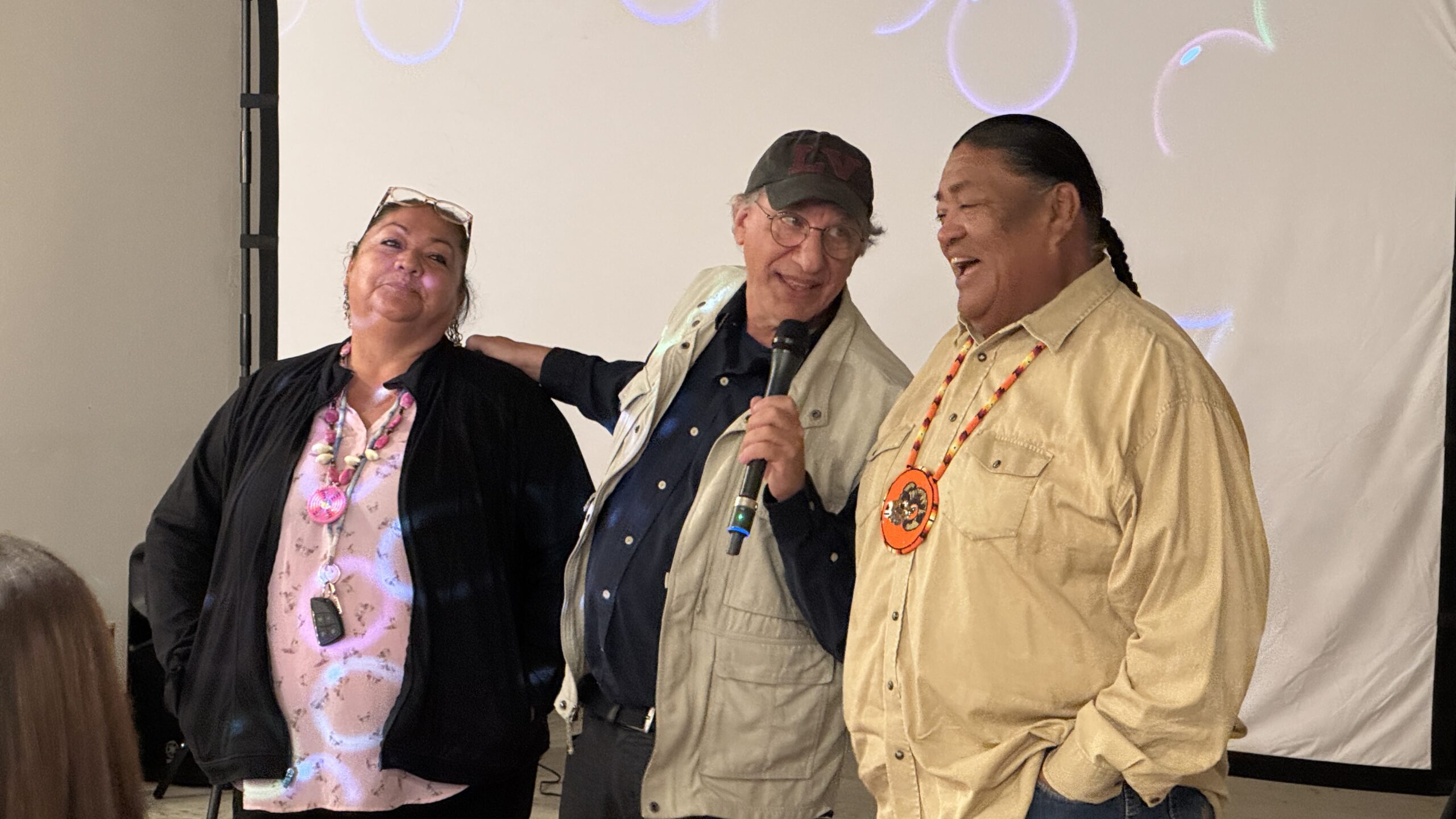
After the screening, Anderson and his wife, Shanandoah Anderson, a Paiute leader, educator and musician whose flute and voice are heard throughout the film, joined Faye at the front of the room (pictured). Anderson questioned whether a man with a club foot could have moved through such rough country. He also rejected the theory that Queho starved in a canyon full of food.
He spoke about how his people have been cast. “We’re very proud people, you know, and we’re still here,” he said. “We’re already marked.” He called the public display of Queho’s body wrong, then addressed an audience that was largely white: “But if that was a trophy, then I guess that’s the way you guys do it.”
Queho’s remains passed through a morgue, private hands, a fairground and a university museum before Wiley claimed them. Anderson did not address Faye’s plan to scan the grave. He had declined Faye’s request to visit it.
He tied that history to the present: “Because right now, everybody’s going through these data centers and everything else.” He said the cultural sites under threat include ones in “this valley right here,” and spoke of “millions of holes” dug into the earth.
Then he talked about Tecopa.
“My relatives lived right here in Tecopa,” Anderson said. He named Juanita Lee and Clyde Lee. “All these people lived here back in the days.” He remembered the family dog: “Big old poodle. His name was Pierre.” He was a small child then, “I think four or five years old,” and the visits stayed with him. “You know, and I still remember coming here and going through the hot springs back in the day.”
Faye thanked the couple. “What you guys do for us is you both,” he said, “you ground us in the humanity of that person.”
Leave a Reply