
Board members gathered last Thursday evening at the Hurlbut Rook Community Center in Tecopa for the April meeting of the the Southern Inyo Fire Protection District, wrapping up in just about an hour — and what moved through that hour was a portrait of a rural fire agency hitting its stride.
A New Ally Arrives
The meeting’s most striking moment came early, before the formal business even began, when a silver-haired stranger rose to address the board.
Dave Heterich, a retired career firefighter with two decades of experience in Southern California and a former industry liaison at MSA Safety, had driven out to Tecopa at the suggestion of his cousin, Ted Faye. He came not seeking a paycheck — he was clear about that — but a purpose.
“I was looking for something to get my head off the pillow,” Heterich told the board, with the easy candor of a man who has earned the right to speak plainly. “And I found it.”
Heterich spent years helping fire departments navigate the labyrinthine world of federal and state grants, and he sees Southern Inyo as a department worth fighting for. When he asked Chief Bill Lutze what it would take to fully fund the district’s needs, the answer came back without hesitation: ten million dollars. Heterich didn’t flinch. He has a plan, he said — a six-to-twelve month runway of cultivating funding relationships — and he intends to see it through. He will coordinate with Board Chair Robin Flinchum, Chief Lutze, and Administrator Mike Jerry, each taking a piece of the work.
“You’re wonderful people,” he told the board before departing. “The service that you provide this community — I’m sure there are a lot of people who are appreciative that you’re here.”
The room received him warmly. When he was gone, the board got to work.
Washington Hears a Small Town’s Voice
If Heterich’s arrival offered a glimpse of what private initiative might accomplish, another piece of news — delivered almost in passing during the Fire Stations long-term planning report — illustrated what political will can do.
County supervisors had recently traveled to Washington, D.C. on a legislative advocacy trip. While there, they sought an audience with officials at the Bureau of Land Management, pressing for the transfer of a parcel of BLM land to Southern Inyo — land the district needs for the planned Tecopa Heights fire station. The meeting went well. Within days of the supervisors’ return, the Barstow field office of the BLM received a direct call from the agency’s Deputy Secretary: move this forward.
“The way to get things done is to fly to D.C.,” one board member quipped, and the room laughed — but the laughter carried real relief.
There was more. A separate conversation has apparently been unfolding between the district and partners involved in a local solar energy project. The possibility of a million-dollar contribution toward the Charleston View station was mentioned — not confirmed, but credible enough that board members visibly brightened. The board agreed to invite community liaison Patrick Donnelly to give a formal update at the May meeting.
Chief Lutze, meanwhile, reported that a Zoom meeting with county planning staff had been scheduled for the following Monday to begin the formal design and cost estimation process for the new station. After years of planning and waiting, the project appears to be entering a new phase.
“As soon as we crack that egg on Monday,” he said, “that’s the official start date.”
On the Ground: Eight Calls, One Busy Baker to Vegas
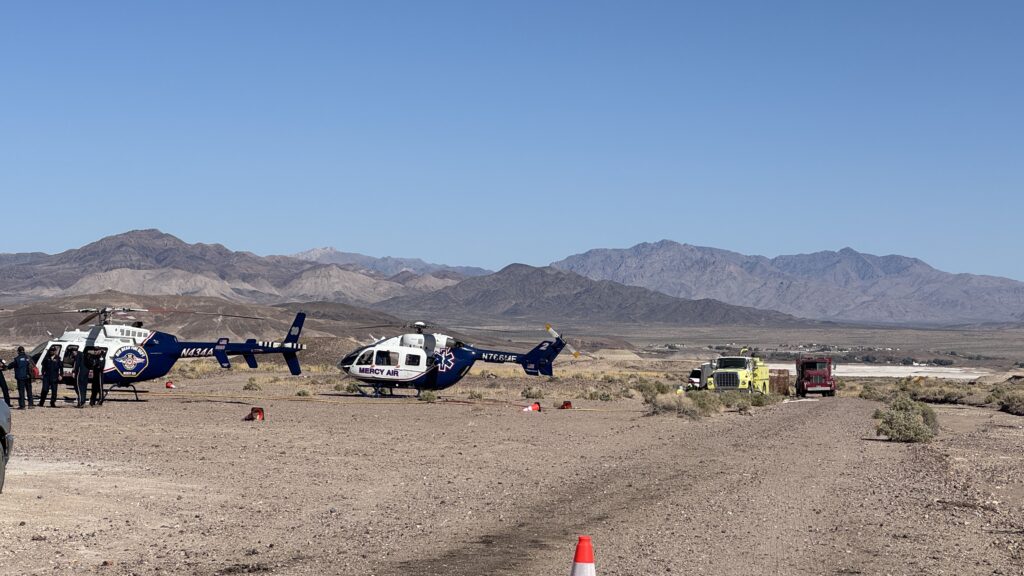
The district’s day-to-day operations showed no signs of slowing. Since the March meeting, volunteers responded to eight calls for service — all medical emergencies.
The month’s most dramatic operational moment came at the Baker to Vegas helicopter relay race, an annual event that threads through some of the most unforgiving terrain in the American Southwest. This year, the district managed twelve helicopter flights — roughly four times the typical volume. At one point, five aircraft were simultaneously on the ground, a situation no one had planned for. Six volunteers improvised a landing zone for the fifth helicopter on the spot and kept the operation running without incident.
A BLS recertification class held April 14th in Shoshone brought nearly all active volunteers together for two-year recertification, with all but one attendee — sidelined by illness — passing the course.
The Bones of the Organization: Finances, Equipment, and Policy
Even in a meeting running at a confident clip, the board made room for the unglamorous work of institutional maintenance — work that determines whether a small public agency can sustain its momentum over the long haul.
On the financial side, Treasurer Colette Zelwer — attending remotely — reported a clean budget picture following months of corrections and reconciliation. She flagged a disputed workers’ compensation insurance bill, which Administrator Jerry is contesting after the insurer applied higher salary figures than the district’s actual payroll warranted. A budget committee meeting was scheduled for May 14th.
The board approved a $4,000 budget transfer to fund the district’s share of electrical and plumbing work at the Tecopa Water Kiosk, necessary to bring the kiosk’s backup generator online. The work will also require a parallel vote at the next water kiosk committee meeting.
For the fleet, one ambulance with a recently replaced transmission is experiencing post-repair issues and is being returned to the vendor under warranty. The rest of the fleet, the mechanic’s report noted, is in fair shape — high praise for a department that operates aging vehicles in extreme heat across hundreds of miles of desert highway.
A long-overdue employee handbook was formally approved after receiving strong marks from the board. The consensus was clear: the document is well-crafted and a genuine asset to the organization. The biannual conflict of interest policy was also reviewed and re-approved without material changes.
A Tank That One Person Can Carry
Sometimes the most meaningful improvements are the simplest ones.
Administrator Jerry brought before the board a proposal to purchase a self-supporting portable water tank for the department’s water tender. The current tank — a 200-pound aluminum-frame structure — requires most of the available crew to deploy, pulling firefighters away from active suppression work to wrestle with equipment. The proposed replacement weighs 75 pounds, can be set up by a single person, and costs approximately $3,100 to $3,500 with shipping.
The logic was straightforward: when a tender has to leave the scene to refill, the engine can continue drawing water from the portable tank and fighting the fire instead of waiting. The board approved the purchase unanimously.
Raising the Antenna, Growing the Reach
On the communications front, the district is taking a significant step forward. A radio repeater is set to be relocated to the top of the Ibex tower site — at 120 feet, more than double its current elevation. The move is expected to dramatically expand pager and radio coverage across the district’s sprawling service area, resolving known dead zones caused by intervening terrain. A coverage test was scheduled for the following Saturday.
The district has also been steadily replenishing its supply of vehicle radio microphones, which deteriorate rapidly in the desert sun. After discovering that the original manufacturer no longer produces the compatible model, Administrator Jerry sourced replacement units on eBay at roughly $30 each. Three have already been installed and confirmed working; three spares are on hand.
Recognizing the People Who Show Up
Director Colette Zelwer raised an agenda item that, in its modesty, said something important about the culture the board is trying to build: how does the district formally thank the volunteers who make everything possible?
The answer emerging from the fundraising committee is straightforward — a thank-you dinner after major events, and volunteer t-shirts that serve both as recognition and as a practical way to identify knowledgeable faces at community fundraisers. It is not a lavish gesture. But it is an acknowledgment that this department runs, above all, on the goodwill of people who show up.
“They really do deserve our thanks,” Zelwer said.
Building the Ranks
Appreciation for existing volunteers is only half the equation. The board also turned its attention Thursday to a more pressing problem: finding more of them — and given that all eight calls since the last meeting were medical emergencies, the most urgent need is for trained EMTs.
One prospective recruit emerged from an encounter that speaks to how a small desert fire district finds its people: Chief Lutze came across someone studying for EMT coursework, struck up a conversation, and made his pitch. The candidate is roughly halfway through the training and has since submitted a partial application — but it remains incomplete. The board’s message was pointed: finish the paperwork, and the district will cover the next leg of your training through its educational assistance program. That offer, however, only kicks in once a candidate has formally completed the application process and been brought on as a volunteer.
The broader recruitment picture illustrated a gap between preparation and follow-through that the board seemed determined to close. The district has an approved recruitment flyer — drafted some time ago, reviewed by the board, then set aside as other priorities took over — and a recruitment page already live on its website. Thursday’s consensus was that the sidelining is over. Administrator Jerry was directed to push both the flyer and the website recruitment link out on Facebook, at least once a month, with board members tagged so the posts travel further than the district’s own followers. Physical posters were also discussed as a complement to the digital push.
The board also asked Administrator Jerry to look into the cost of paid Facebook advertising, acknowledging it may not be the right fit for a district of Southern Inyo’s size and reach, but agreeing it was worth knowing the number. Someone also raised the possibility of public service announcement placements — a potentially cost-free channel — and agreed to look into whether the district would qualify.
This reporter volunteered to bring social media and advertising expertise to bear on the district’s recruitment outreach, working with Administrator Jerry. With summer approaching and the seasonal population beginning to thin, the board acknowledged the timing is far from ideal. But for a department that runs on volunteers and answers medical emergencies around the clock, there is no convenient season to go looking for them.
Looking Ahead
The ballot measure to increase the district’s Measure J tax assessment — long discussed as a potential financial lifeline — was formally tabled until mid-2027, with an eye toward a 2028 election cycle. The board’s reasoning was pragmatic: without firm construction cost estimates for the Charleston View station, and without a clearer picture of what other funding may materialize, asking voters for more money would be premature. Better to build the case carefully than to rush a measure onto the ballot and lose.
It was, in the end, the kind of disciplined patience that only comes from an organization that finally knows where it is going. In a little over an hour, Southern Inyo Fire Protection District checked off a full agenda, welcomed a new ally, moved several long-running projects decisively forward, and adjourned while there was still some light in the sky.
The next regular board meeting is scheduled for Thursday, May 21st at 6:00 PM in Tecopa and Zoom.
Southern Inyo Fire Protection District serves the communities of Tecopa, Shoshone, Death Valley Junction, and surrounding areas. For more information, visit sifpd.org or call (760) 852-4130.
Leave a Reply