
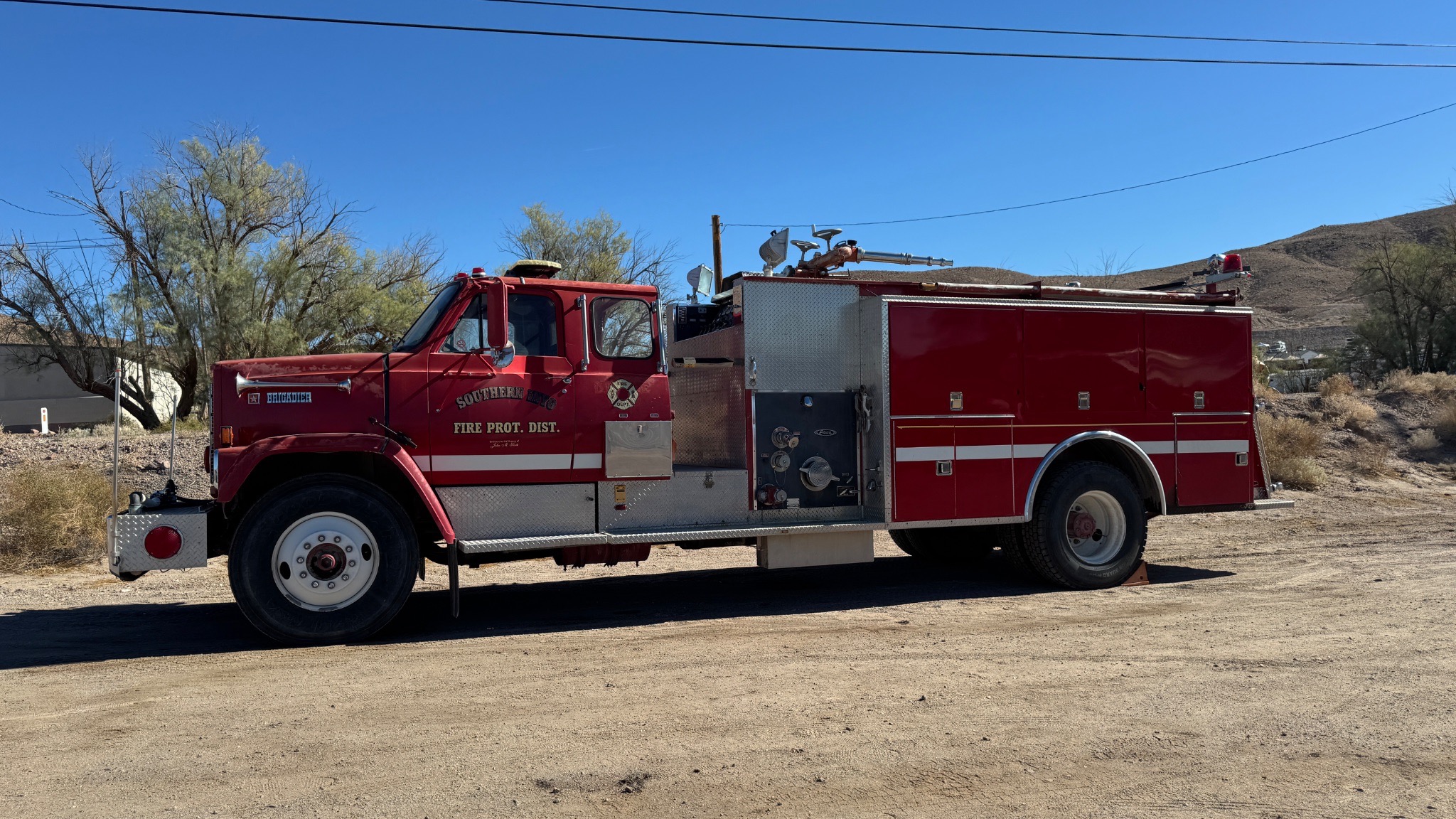
The Southern Inyo Fire Protection District’s February 19 board meeting gave a few headlines among the slow work of keeping a rural district stitched together: a proposed cell tower above Shoshone, a first-time reggae festival on private land, a possible future tax assessment, and the true cost of a parcel for Charleston View’s forthcoming substation.
By the time directors wrapped up at St. Therese Mission Catholic Church in Charleston View, they had moved routine business, heard a detailed tower pitch, worked through mid-year budget fixes and a payroll correction, adopted a new social media policy, and given serious attention to some fundraising experiments that could shape how the district pays its bills over the next few years.
Tower plans and landline fears
Directors dispensed with their first order of business. In a single motion they approved the January minutes, ratified last month’s edits to board policy, and authorized installation of an electrical transfer switch at the water kiosk by D&J, a small infrastructure upgrade intended to make operations less fragile when the power flickers.
The first major agenda item belonged to Rusty Lewellen of DW Tower, LLC, who is seeking to build a new communications tower on Bureau of Land Management land near Shoshone. Lewellen told the board that propagation modeling suggests the tower would throw service roughly seven to eight miles in each direction. That would significantly improve coverage down-valley from Shoshone, he said, but would not completely erase gaps as far away as Charleston View or Tecopa once the hills and folds of the landscape are taken into account. He promised to provide the district with maps showing the modeled footprint.
Lewellen described BLM siting as the preferred path technically, but warned that it is also the slowest. A tower on federal land triggers cultural, biological and archaeological review, even on already disturbed ground, and he estimated the permitting process could stretch to about two years. Siting on private land could move faster, he acknowledged, but would bring a different fight over location, viewshed and neighborhood support.
Board members zeroed in on whether the project would actually make their own work easier. They asked if Southern Inyo Fire and the Sheriff’s Office could place repeaters on the structure. Lewellen said the tower is being designed with dedicated space for public-safety equipment and that he fully expects to accommodate both agencies. He also asked for letters of support to help with regulators and funders. Directors replied that SIFPD has already submitted one and urged him to cultivate similar backing from county officials.
Running under the technical discussion was a quieter concern about unintended consequences. Several directors voiced worry that if cell coverage improves, AT&T could use that as a reason to remove landlines from the valley. No one had a firm answer, but the board said the risk out loud and framed it as something the community may eventually have to prepare for if copper is pulled in favor of wireless.
Calls, cash and keeping rigs running
In his report, the Fire Chief said the district had responded to eight calls since the last regular meeting, a split of EMS-only runs and combined EMS and fire responses, including four motor vehicle accidents and separately, one fatality. He also noted a January 28 site visit where crews took measurements and staking for a planned station site, and a February 17 all-staff debrief to unpack recent incidents and share lessons learned.
The treasury report put numbers to a familiar pressure. The district has raised about $8,789 toward a $17,000 fundraising goal, with only one significant event left before the fiscal year closes in June. Last year’s county-backed fundraising grant yielded a smaller benefit than it could have: catering costs for the supported event stayed uncertain until late, there were no other eligible expenses to submit, and as a result only about $6,500 to $6,600 of a $7,500 allocation was used. Directors said they are still navigating the mismatch between the county’s fiscal-year grant approvals and the district’s calendar-year fundraising cycle, and they confirmed that the grant is narrowly written to subsidize fundraising activities—they cannot simply redirect unspent money to everyday apparatus maintenance.
The administrative report was prosaic but revealing. Staff are still working to set up a Google Voice line that can accept text messages for new accounts and have run into quirks on Google’s end. Personal protective equipment orders for new volunteers are moving forward under existing grants. A standard disclaimer for the district’s YouTube videos still needs to be finalized between the administrator and a board member. And the district has received an annual invoice of roughly $1,500 from Streamline for website hosting and support, about the same as last year.
On the mechanical side, the fleet update underscored just how much energy goes into keeping the district’s vehicles roadworthy. One ambulance is temporarily out of service for heating and air conditioning work, with another rig covering its territory. The FireCat wildland unit has been serviced and is back in operation, with plans to load it with water. Piping work on the water tender is expected to take that apparatus off the line for several days once it begins, forcing the district to juggle coverage while critical repairs are made.
Water kiosk in good shape, looking for shade
The water kiosk committee reported that the kiosk is operating smoothly. Inventory and documentation work continues, with an emphasis on writing down testing protocols and procedures so the system rests on more than institutional memory. Committee members are also looking at a portico or shade structure over the fill area to protect users and sensitive equipment from the desert sun and to cut down on heat-related wear. A vendor has already visited the site; the committee expects design ideas and cost estimates before returning to the board with a formal proposal.
Weird Tales and a reggae test run
Fundraising occupied a significant stretch of the agenda. One concept on the table is a “Weird Tales Festival” with filmmaker Ted Faye, centered on a film premiere, a ticketed dinner and tented programming—an attempt to build a signature annual fundraiser rather than relying on small, scattered efforts. Directors talked about setting a clear fundraising target for the event and, if gross revenue exceeds that target, sharing any excess with the outside organizer. They were clear that any agreement would have to return to the board with an itemized budget before SIFPD committed money. The board ultimately agreed to keep developing Weird Tales as the district’s primary fundraiser for the year.
More immediate is the upcoming March 21 music festival at Kit Fox Café, which John Fuller framed as both a near-term reggae show and the seed of a longer-running general music event. He told the board he spent about two months in the county permit process, dealing with four or five departments, and was only sent to the fire district after those approvals were in hand. In the end, he said, the county determined he did not need one of the permits he had pursued because of the event’s size, its location on private land and his status as a restaurant owner for food service.
Fuller’s special event permit allows up to 400 people. He said he is actively trying to keep attendance at or below that cap and, given that tickets are not yet “flying out the door,” expects the crowd to come in under the maximum. The festival is scheduled as a single Saturday, currently advertised as running roughly from noon to 10 p.m., a window he expects to tighten as planning advances.
He stressed that he does not need anything from SIFPD to put on the show, but would “love to have you guys there.” He invited the district to set up a merchandise table and said anyone from the room who attends would not have to pay. He sketched a vendor plan in which booths rent for about $80 and vendors carry their own liability insurance. He has purchased a one-day event policy for the festival and said the same provider can issue single-day policies to small vendors.
The main interface with the district is medical coverage. Fuller said community members had suggested having SIFPD’s second ambulance on site. He offered to pay for the ambulance presence and to make an additional donation, while acknowledging that emergency calls would remain the priority and the rig would need to be free to leave. District representatives responded by describing the Tecopa Fest model, in which the organizer hires their regular EMT, Billy, directly and the district brings an ambulance in exchange for a donation. SIFPD does not issue permits, they reminded him, but does need early notice about large gatherings so staffing, timing and response expectations can be worked out. The exchange was cordial and pragmatic: Fuller left with a clear understanding that this is his first festival at this scale, and that any arrangement must preserve the district’s ability to answer everyday calls.
Stations, land, and new recruits
Under long-term planning, directors returned to the slow-moving question of where future stations will actually sit. A previously gifted county parcel is now viewed as unrealistic once infrastructure and flood-mitigation costs are factored in—an example of how “free” land in the wrong spot can quickly become unaffordable. Attention has shifted to a property tied to the Mary Wiley Trust. A letter from the trust offers up to four years from November 2025 for the district to construct a station, says title will not be conveyed until funding is secured and construction is ready to begin, and asks for about 60 days’ notice before work starts so the deed can be finalized. That structure runs head-on into common grant requirements, which usually demand proof that an agency controls the property before money is awarded. Directors floated the idea of a long-term, nominal-cost lease as a way to satisfy “site control” rules in advance of full transfer, with legal and financial details still to be worked out.
Volunteer recruitment surfaced as both concern and opportunity. Board members discussed hosting a community training day as a low-barrier entry point into support roles such as basic fire extinguisher use and traffic control. During the meeting, two 18-year-old residents introduced themselves and said they want to pursue firefighting. The board and staff referred them to the Fire Chief, handed them applications and outlined possible training paths, giving a glimpse of a potential homegrown pipeline.
Radios, taxes, tanks and tune-ups
In old business, directors reported that the county’s mid-year budget will pay to move the existing repeater from Ibex Pass to a site closer to the Sheriff’s substation in Shoshone, based on updated coverage mapping. They also described an agreement with Nye County to mount fire and sheriff repeaters on a tower on Homestead Road, a change expected to significantly improve radio coverage in Charleston View and let volunteers there reliably receive tones. The goal is to complete that work before summer heat makes site visits more difficult. Self-contained breathing apparatus work remains in progress.
On the revenue side, the exploratory committee on a possible future special tax assessment said more homework is needed: detailed capital plans for new stations, operating budgets after build-out, and a clearer picture of potential revenue from nearby solar development. A 2026 ballot now looks unlikely; 2028 was floated as a more realistic target if that groundwork can be done.
Closer to the ground, the board is still waiting on a firm quote from Amerigas to plumb and install a propane tank for the generator, and reassigned responsibility for chasing it so the project moves forward. Directors revisited the question of whether to connect the well directly to the fire tank now or wait until a larger waterline and tank project is defined. Filling the tank by tender is labor-intensive, but no one wants to build piping that might later be torn out. The board leaned toward timing the connection to coincide with the broader project.
New business mixed policy and small corrections. A proposal for more formal volunteer recognition was introduced but tabled at the treasurer’s request. The board read a letter from Cynthia Kienitz thanking SIFPD for taking up concerns about CAL FIRE hotel inspection billing and for sending a follow-up letter in December 2025, and urging them to consider revisiting the issue with more specific questions. Directors then adopted a new social media policy drafted by Bill Lutze, covering both official accounts and how individuals represent the district and handle sensitive information, and requiring officers to provide an annual list of authorized account users. A spending-limit change to board policy 2010 was postponed after staff realized the agenda cited the wrong section; it will return with the correct reference.
The board approved a retroactive payroll correction for administrator Mike Jerry, who had not been paid the intended two hours per month at $18 an hour from the water kiosk budget for the first seven months of the fiscal year. They also signed off on mid-year budget amendments that restructure vehicle and equipment maintenance lines to distinguish labor from materials and cover known and anticipated repairs, shift money out of an overbudgeted insurance line, raise expected EMS (Maddy) grant revenue to reflect an award now projected to exceed $20,000, and direct additional funds into general operating, repair and kiosk-parts needs.
Buying “free” land and what comes next
In “Good of the Order,” directors circled back to the question of land and money. Several suggested it might ultimately be cheaper to buy an already permitted property in Charleston View—with water, sewer and power in place—than to keep chasing free parcels that come with massive infrastructure costs. The thought captured the theme of the night: in Southern Inyo, nothing is truly free, and every decision is a balancing act between what the district can afford now and what it will need tomorrow.
The board closed by setting its next regular meeting for Thursday, March 19, 2026, at 6 p.m. in Tecopa, and by repeating the reminder that while Zoom is allowed, at least one board member has to be physically inside the district for any of these decisions to count.