
There is a worn path carved out by the county officials traveling four hours southeast of Bishop on the long road down through the northern Mojave, where the scale of Inyo County becomes visceral rather than statistical. The mountains recede. The highway narrows in the imagination if not on the map. The communities grow smaller and farther apart. And then you arrive in Tecopa — a desert outpost near the Nevada border, near the edge of Death Valley, near what sometimes feels like the edge of everything — and you find, packed into a community center on a Tuesday afternoon, a room full of people who have a great deal to say to their government.
The Inyo County Board of Supervisors holds semi-annual meetings in Tecopa, and the April 14 gathering at the Hurlbut Rook Community Center was, by any measure, a full one. The agenda ran from telephone service to endangered rivers, from a national park losing nearly half its workforce to a fire department dispatching emergencies over WhatsApp, from a land donation with nine figures of bureaucratic complexity to a fire station that may — finally, after years — be within reach. The supervisors asked questions, took notes, and left with a long list of things to do and a longer list of things they cannot easily fix.
The AT&T Crisis
The meeting’s opening hour was consumed almost entirely by testimony about AT&T’s failure to maintain landline service in Southeast Inyo County — a crisis detailed in a separate report linked below. The short version: multiple residents described extended outages, missed repair appointments, and an inability to reach anyone at AT&T with the authority or willingness to help. An elderly woman spent twenty hours on hold. A volunteer firefighter spent three months — up to seven hours a day — trying to transfer a landline and got nowhere. A 102-year-old elder in the Timbisha Shoshone’s Death Valley Indian Village has no way to call for help overnight because AT&T refuses to restore service that was previously disconnected.
The board indicated it would consider writing formal letters to the California Public Utilities Commission and to the county’s state legislators. Residents were directed to file individual CPUC complaints at cpuc.ca.gov or by calling 1-800-649-7570. A formal resolution demanding AT&T honor its carrier-of-last-resort obligations was requested.
Inyo County Road Maintenance Supervisor Shane Rily told the board: “I believe there’s an active investigation because some people came out and cut the phone line down from Shoshone to Tecopa. And when the service truck came out to fix the one section, they cut two more sections down. They said it’s happening from Bakersfield all over. They’re going out in the desert and they’re just cutting the phone lines down and they’re scrapping them. They’re having a problem getting a new line up before they fill it again.” His testimony prompted TecopaCabana to seek comment from both the Inyo County Sheriff’s Office and AT&T.
Lindsey Stine of the Inyo County Sheriff’s Office said: “An investigation is ongoing into incidents involving multiple sections of the same phone line being cut during nighttime hours. Based on information gathered so far, this does not appear to be isolated to our area, and similar activity has been reported elsewhere in Southern California. We are coordinating with AT&T and the Bureau of Land Management as part of the investigation. At this time, impacts appear to be limited. To our knowledge, only one resident has been directly affected by a service disruption and has since implemented alternative communication methods. Most residents in the area appear to still have access to Wi-Fi and are able to contact 911 in an emergency. No additional service issues have been reported to us at this time. We ask the public to remain aware of any unusual activity, particularly vehicles in remote areas near utility lines during nighttime hours that do not appear to be associated with utility or official personnel.”
AT&T responded: “We’re working to restore service for customers affected by ongoing copper theft activity at this location. We’re actively working on restoration efforts and will complete repairs as soon as possible. We apologize for the disruption and appreciate our customers’ patience as this work continues. We recognize the important role communications services play, and we remain committed to maintaining reliable, high-quality service for our customers. Theft and vandalism of critical communications infrastructure are serious criminal matters that can disrupt service for customers and the surrounding community. We are in contact with local law enforcement regarding the ongoing thefts at this location.”
What AT&T did not address is the gap at the center of Tuesday’s testimony. TecopaCabana followed up with two pointed questions: whether the company intends to address the preexisting service issues around landlines in Tecopa that predate the copper theft, and — given that law enforcement says the vandalism has affected only one customer — how AT&T accounts for all the other residents who testified to service disruptions. The company did not respond.
Full coverage of the AT&T situation can be found here.
The Law Comes to the Desert
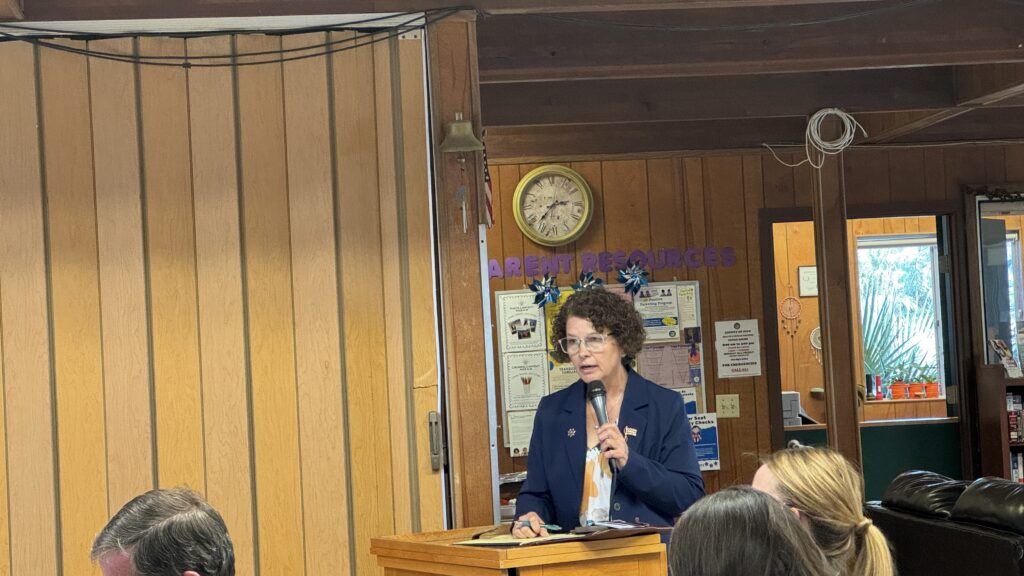
District Attorney Dana Crom made the long drive down to deliver a report that was, in its own way, a reminder that the apparatus of government extends even to the far end of Inyo County — imperfectly, with effort, but with intention.
Crom reported that the county’s Victim-Witness program has secured funding for another year — no small thing, she noted, given that the funding had been uncertain both last year and this year. The program, which draws on federal and state funds to provide services to crime victims, has been restructured in response to those funding pressures. All support staff have been reclassified as legal advocacy specialists, each assigned directly to a prosecuting attorney. The result is a team-based model in which every victim has both an attorney and a dedicated advocate working their case together. “If you need services from our department, please reach out,” Crom told the room. “There are a lot of things we can assist you with if you are a victim of a crime.”
She was candid about the particular challenges of providing those services in Southeast Inyo. Transportation is a significant barrier — getting to court, being heard, navigating a system whose physical infrastructure is concentrated hours away. The county is aware of that, she said, and the restructuring is in part an attempt to address it.
On a more optimistic note, Crom announced that the office will be fully staffed as of this past Monday, with the hiring of a new deputy DA. The incoming attorney comes from the environmental sector rather than criminal law — a background Crom described as a natural fit for South County, where issues involving illegal roads and other land-use matters are a persistent part of the docket. “Her history of being an environmental lawyer will blend nicely with the office,” Crom said.
Learn more about the Inyo County District Attorney’s Office here.
A Park Losing Half Its People
Death Valley National Park Superintendent Mike Reynolds offered a reminder about the sheer scale of the geography before him. Inyo County is the ninth largest county in the United States. Fifty-two percent of it sits within the park. Ninety-four percent of Death Valley National Park sits within Inyo County. Between 1.5 and 2 million people visit from around the world each year to experience a landscape that contains, among other things, the hottest place on Earth — which in March 2026 set a new record by five and a half degrees above any previous March temperature, killing the season’s super bloom just as it reached its peak. The flowers lasted three weeks. The visitors arrived after seeing it on television.
Against the grandeur of that backdrop, Reynolds delivered a different kind of news. Since January of last year, park staffing has fallen by approximately 45 percent — from around 120 year-round employees to roughly 68. Scotty’s Castle is now closed indefinitely. Water systems at Emigrant and Wild Rose campgrounds have been shut down. Major infrastructure repair projects are suspended. “Our ability to execute tasks” has been severely compromised, Reynolds said, with the measured understatement of a federal official choosing his words carefully in a public forum.
Progress continues where it can. A $62 million water and wastewater replacement project at Furnace Creek — replacing collapsing systems that serve the park’s highest-traffic area — is underway and expected to take three years. The Salt Creek boardwalk, destroyed in the catastrophic 2022 floods, has been rebuilt and reopened. A new mutual aid agreement with the Inyo County Sheriff gives park rangers concurrent jurisdiction to enforce state and local laws alongside county deputies — a meaningful improvement in public safety capacity as both agencies contend with declining headcounts.
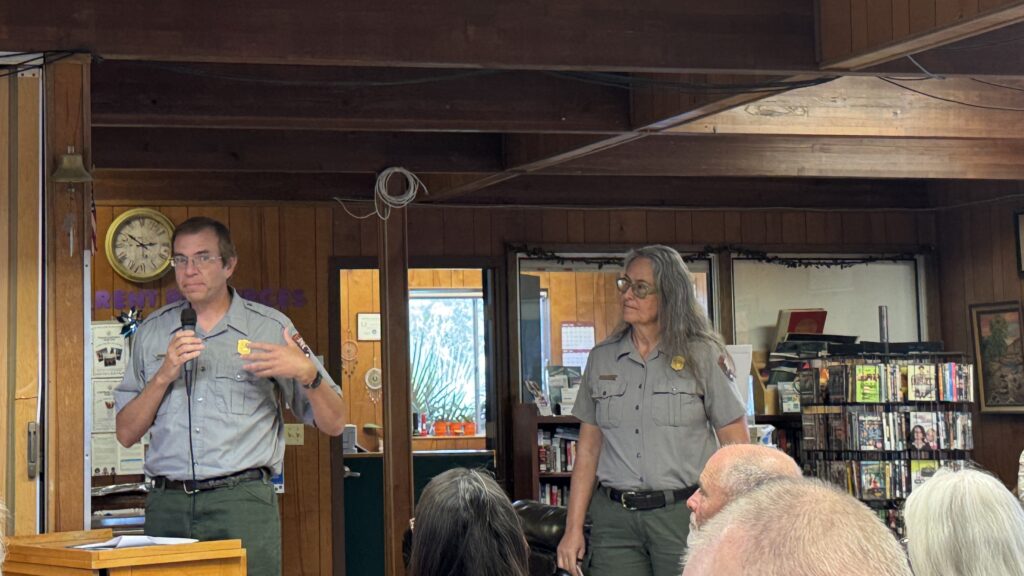
Deputy Superintendent Abby Wines updated the board on the proposed Rio Tinto land donation — 3,209 acres including all of 20-Mule Team Canyon Road and roughly half of the beloved Golden Canyon hiking loop. To understand why this donation is complicated, it helps to understand who Rio Tinto is.
Rio Tinto is one of the largest multinational mining corporations in the world, headquartered in London and Melbourne, with operations across six continents. Its revenues run to tens of billions of dollars annually, and its portfolio spans iron ore, copper, aluminum, and lithium, among other commodities. In the American West, the company has long been present through its subsidiary U.S. Borax — the company behind the famous 20-Mule Team brand and the historic borax mining operations in Death Valley that shaped the region’s identity throughout the twentieth century. U.S. Borax has operated in this landscape for generations, and its lands — including the 20-Mule Team Canyon corridor that thousands of visitors traverse each year — have effectively functioned as de facto public access lands even while remaining in private hands.
Rio Tinto is now selling U.S. Borax. The lands go with it. The buyer is unknown. Whatever mining corporation acquires the subsidiary may have no interest in maintaining public access, no connection to the region’s history, and no relationship with the communities that have long treated those landscapes as their own. That is the fire lit under the donation process: Rio Tinto wants to transfer the land to public stewardship before an unknown corporate successor takes ownership. The preferred recipient is Death Valley National Park, but a Department of the Interior policy requires a letter of support from Inyo County before the transfer can proceed — a requirement Rio Tinto is currently seeking a waiver from. If no waiver is granted, the company’s backup options are the Bureau of Land Management, which has no such requirement, or a private land trust.
The financial stakes are local and significant. If the land moves from Rio Tinto’s private ownership to federal ownership — whether National Park Service or BLM — Inyo County’s annual tax revenue from the parcel falls from approximately $32,000 to roughly $1,300, cushioned only by a five-year federal payment-in-lieu-of-taxes transition at full value. Robin Flinchum, speaking from the audience in her capacity as SIFPD board chair, noted that the fire district derives its income from a special tax rather than property taxes, meaning even the PILT transition would provide no relief for SIFPD. Death Valley Unified School District and Southern Inyo Hospital face similar impacts. Rio Tinto has stated it is not interested in creating an endowment to offset those losses. Several supervisors are scheduled to attend a Park Partners Dinner later that week where a Rio Tinto representative will be present — an opportunity Wines described as potentially useful for a direct conversation about the endowment question.
The Most Endangered River in the West
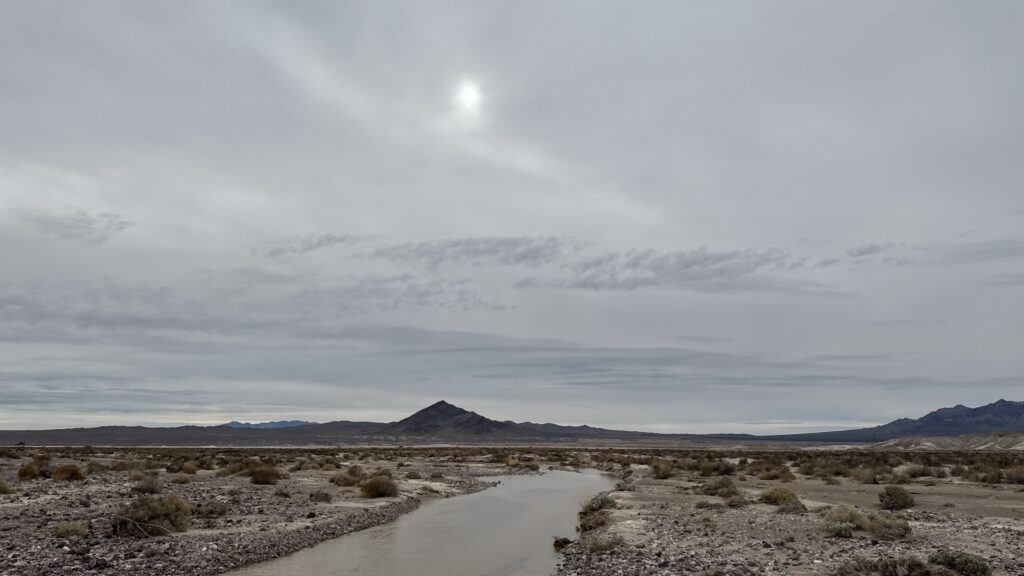
Mason Voehl of the Amargosa Conservancy brought news that is simultaneously alarming and galvanizing: the Amargosa River has been formally named one of the ten most endangered rivers in the United States. It is a distinction earned not through resignation but through urgency — a recognition that the threats facing this small, ecologically extraordinary desert waterway have reached a level demanding national attention.
The threats are multiple and largely external to California. Mining operations, utility-scale energy projects, and the proposed North Bullfrog Mine near the river’s Nevada headwaters all pose risks to the hydrological system that supplies water not just to the river itself but to Death Valley, the Timbisha Shoshone tribe, and the communities of Shoshone and Tecopa. A federal mineral withdrawal that would protect approximately 309,000 acres of Nevada land hydrologically connected to California’s Ash Meadows has been stalled under the current administration; its two-year segregation period expires in January 2027 with no action in sight.
Into that void, something remarkable has happened. The township of Amargosa Valley, Nevada — a community historically skeptical of, if not at times outright hostile to, conservation efforts — passed a resolution calling for the designation of an Ash Meadows National Conservation Area. The Beatty Town Advisory Board echoed the call the following day. For communities that draw their water from the same system as Tecopa and Death Valley, and that sit upstream of multiple proposed large-scale mining operations, the shift is striking. “It’s hard to overstate how significant that is,” Voehl said. He told the board he will be bringing a formal action opportunity to them in the coming months — asking for their support of the Nevada conservation designation, on the grounds that what happens upstream does not stay upstream.
The Conservancy also reported progress on restoration projects funded by the California Wildlife Conservation Board — focused on wetland and riparian habitat, recreation access, interpretive signage, and the Amargosa Vole, one of the region’s flagship endemic species. (TecopaCabana covered that here.) A comprehensive Wild and Scenic River management plan, one of the most consequential planning documents in the American West, is due from the Bureau of Land Management by September 30 of this year. Voehl urged the county to engage in that process at every step. It may be, he said, the most powerful tool available to protect the river’s water supply against upstream over-pumping for decades to come.
An audience member raised the question of radioactive contamination from the Nevada National Security Site — specifically, whether mining-related water pumping could increase the flow of contaminated groundwater toward the region. Voehl acknowledged USGS has studied the question and that increased pumping from proposed large-scale mines near the river’s headwaters could accelerate groundwater movement from the test site. Mandi Campbell, a lifelong area resident and member of the Timbisha Shoshone tribe, noted this has been a known threat since her childhood: “It’s always been a threat that’s been going on, but the more mining and the more stuff that happens without protection, it’s going to happen in some places. It doesn’t have to happen everywhere.”
A Monument, a Coalition, and the Grassroots Long Game
Cameron Mayer, executive director of Friends of the Amargosa Basin, delivered the update on the Amargosa Basin National Monument campaign with the measured optimism of someone who has learned to take the long view. Three tribal nations have formally endorsed the effort. Mandi Campbell has been brought on as coordinator of a growing tribal coalition. The November 2025 Board of Supervisors resolution of support has become a document Mayer brings to every meeting, built, he said, “Frankenstein style” from real community input and tangible concerns. “I could not be more proud of it.”
Outreach has extended up the political ladder: San Bernardino County officials toured the landscape this past February, accompanied by Supervisor Wadelton. Senator Alex Padilla’s office has received a formal briefing. Congressmen Kiley and Obernolte’s offices are being kept informed. Down the line, Mayer said, the campaign seeks congressional champions to introduce formal legislation — built from the community up, carrying the resolution, the letters, the tribal endorsements, and the years of grassroots work into law.
Getting into the FLOW
Local resident James Davis stepped to the microphone during public comments not to speak for himself but to read a comment on behalf of Cynthia Kienetz, a Tecopa resident and business owner whose work commitments kept her from attending in person. The comment announced the launch of FLOW — Land, Water, Voice — a local initiative that arrives at a particular moment in the Amargosa Basin’s public life, when the volume of consequential decisions about the region’s future is accelerating faster than many residents feel they can track.
FLOW is not, Davis was careful to establish on Kienetz’s behalf, a position. It does not advocate for or against the proposed Amargosa Basin National Monument, nor does it align itself with any particular interest in the many overlapping conversations currently shaping the region’s future. Its purpose is more foundational than that: to identify the questions that matter most to the public, put them in writing, direct them to the relevant organizations and decision-makers, and share the responses openly so that information about what is happening — and why, and by whom — is available to everyone rather than circulating only among those already inside the process.
The first set of FLOW questions will be submitted shortly to Friends of the Amargosa Basin, who will be asked to respond in writing. Those responses will then be made publicly available — so that any resident who wants to understand what Friends of the Amargosa Basin thinks, plans, and intends regarding the basin’s future can simply read it. The initiative envisions directing future question sets to other organizations involved in shaping the region — creating, over time, a straightforward public record of where each major stakeholder stands and what they are doing.
The goal, as Kienetz framed it, is transparency in a landscape where consequential decisions are accumulating rapidly and the gap between those making them and those living with them can feel very wide.
Dispatching Emergencies Over WhatsApp
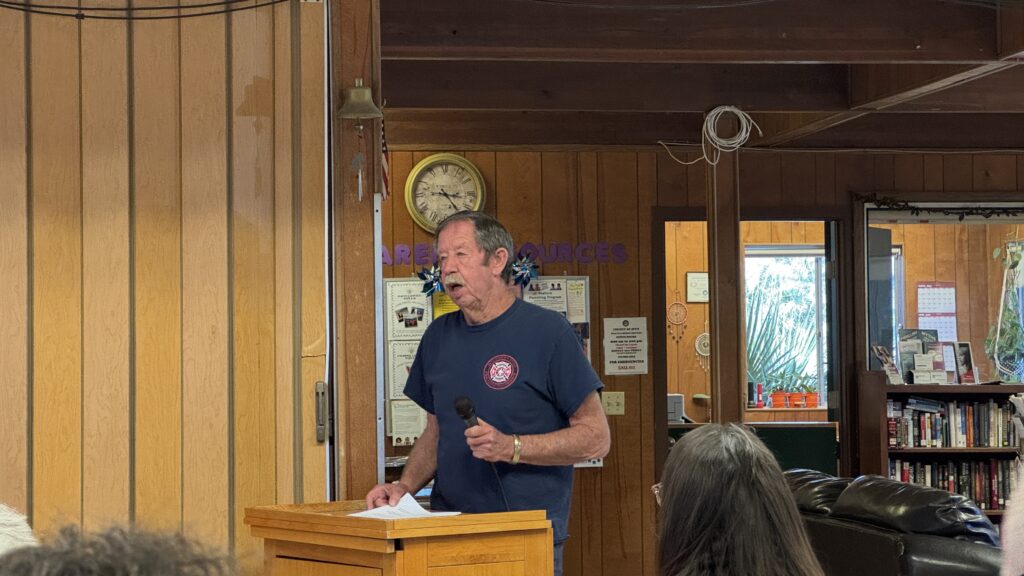
The Southern Inyo Fire Protection District’s update to the board came from Fire Chief Bill Lutze — who has worked in this region since 1973 and has watched its communications infrastructure decline with each passing decade.
He described in plain language exactly how his volunteers are currently notified of emergency calls. Dispatch sends a page. The repeater on Ibex Pass, degraded by years of deferred maintenance, reaches one or two personnel — sometimes none. Those who receive it call dispatch to find out what the emergency is. The department then notifies the rest of the crew via WhatsApp. “You can imagine what the delay time is,” Lutze said, “from the time somebody calls to the time that we actually get going.”
The county’s Chief Information Officer, Noam Shendar, who is in charge of Inyo County Information Services, addressed the communications failures directly. The following weekend, he reported, the fire radio repeater on Ibex Pass will be moved to the very top of its tower — not to a new tower, but higher on the existing structure — to improve signal reach into Tecopa Heights, where the majority of SIFPD’s volunteer personnel live. The move is expected to meaningfully expand the number of firefighters who receive reliable pages.
Beyond that immediate fix, Shendar reported that the county is working with Nye County, Nevada on a lease agreement currently under review by county counsel. Nye County is offering the county a position on one of their towers at no charge, on which Inyo County would install a repeater. That repeater, once operational, should provide fire and sheriff communications coverage to the Charleston View area — a stretch of the county where, Shendar confirmed, there are currently essentially no reliable radio communications for emergency responders. Separately, a private company has submitted a proposal to install a cell tower on BLM land in the area; the board has already submitted a letter of support for that project, though Lutze estimated the timeline to completion at two years at best.
Larry Levy, a firefighter and longtime area resident, added a practical observation during the communications discussion: looking out the window of the community center, he noted, one can see an AT&T microwave relay station directly across the highway. AT&T’s cell antennas are positioned on Ibex Pass, behind the mountain from Tecopa, meaning the community receives no benefit from them. He suggested that the relay station across the highway might be a candidate for additional antenna placement.
Levy also shared a discovery about smartphone emergency settings: every smartphone contains an emergency information feature accessible even when the phone is off, allowing first responders to view emergency contacts, medications, and physician information without a passcode. In a community with unreliable phone service and a medically vulnerable population, he urged every resident to configure it. Read more on how to use a phone in Tecopa.
A New Fire Station
The question of a permanent fire station has haunted this community for decades. EMT Billy Eichenbaum, toward the end of the meeting, asked the assembled officials with undisguised weariness whether one would ever actually be built. “I’ve been doing this 28 years,” he said, “and I’m tired of reaching for equipment that falls apart in my hands because of the heat.”
The answer came from Meaghan McCamman, the county’s project coordinator for the fire station effort, who provided a detailed accounting that was simultaneously encouraging and sobering.
The county secured $1.5 million in USDA grant funds in 2024 to move two fire stations forward. The county is contributing an additional $500,000 match, covering staff time, permitting, and related costs. McCamman acknowledged candidly that $1.5 million will not build two fire stations — and the county has been working carefully to determine how to maximize what is achievable within that envelope. The approach has been methodical: regular coordination meetings with SIFPD staff, board, and Chief Lutze; site planning; environmental health review.
A site plan for the Tecopa station is now approved and has cleared environmental health review. The leach field is confirmed to be a sufficient distance from the sewer line, which is a sufficient distance from the water supply infrastructure. SIFPD recently submitted a revised wish list for the building program, and building inspector Tyson Sparrow reviewed it and concluded that the full list exceeds what the available funding can cover. McCamman and SIFPD will meet within the next week or two to determine what must be pared back to bring the project within budget — with the goal of arriving at a building program that can actually be built.
Once that is resolved, McCamman said she hopes to obtain the letter of conditions from the USDA within the next one to two months. From that point, the county has five years to spend the grant money — a window the USDA has indicated it manages with some flexibility.
The most significant remaining obstacle had shown signs of movement that very morning. The site for the Tecopa fire station sits on a BLM-leased parcel that must be formally transferred to SIFPD before the county can legally expend the grant funds on it. During a recent trip to Washington D.C., Inyo County supervisors met directly with BLM officials and made clear — sternly, McCamman said — that the county needs possession of the parcel before it can begin spending. On her way to Tecopa that morning, McCamman received a call from the local BLM officer, who reported that the BLM assistant secretary had telephoned from Washington D.C. directing them to resolve the parcel transfer. “We got a little traction there just this morning,” she said. “Exciting stuff.”
Robin Flinchum reported that the water kiosk — a separate SIFPD project — will have its propane generator connected one week from the meeting, finally enabling the kiosk to remain operational during power outages.
Fundraising for the Effort
The SIFPD’s new annual fundraiser has a name that announces itself: the Weird Tales Festival — the WTF — scheduled for November 7, 2026 at the Hurlbut Rook Community Center in Tecopa. Built around filmmaker Ted Faye’s Death Valley Weird Tales series, the event will open Friday evening with the premiere of Faye’s latest film and a catered dinner, then expand Saturday into a full day of storytelling, vendors, music, field trips to local sites including Tecopa Mines and the Amargosa Opera House, and a free film and dance party to close the night. The beloved Sarah Jane Woodall — known to her considerable following as Wonderhussy — will return to the program.
Flinchum offered a clarification to anyone inclined to take offense at the characterization of their desert as weird. “This is a celebration of all that is unusual, unexpected, out of the ordinary in this place we call home,” she said. “The desert is not like other places. Weird things happen here. And that isn’t just aliens and outlaws — it’s the feel of the heat in the hottest place on Earth, the sting of a Tecopa bomber, the silence you can’t find anywhere else in the world.” She described the event as “a portal to the Church of the Weird” and invited the room to come find out what that means — adding, with characteristic candor, that she isn’t entirely sure herself yet. It is, she said, very much in the process of becoming.
Connecting Tecopa
A professional services contract with Dokken Engineering of Folsom was approved for up to $1,538,383 to design the Connecting Tecopa bicycle and pedestrian safety corridor — a project that has been years in the making and reflects the tension between the community’s modest scale and the full machinery of infrastructure planning that any federally funded project must pass through before a shovel touches the ground.
The project is more complex than it might appear from the outside. What reads on paper as a pedestrian and bicycle safety corridor is, in practice, a network of interconnected improvements addressing what residents and county staff describe as genuinely dangerous conditions in and around downtown Tecopa. The scope includes south sidewalk construction, curb ramps, and pedestrian refuge islands — raised medians that give pedestrians a protected stopping point mid-crossing — at multiple locations throughout the community, including near the school.
At the heart of the project is the problematic Y-intersection in downtown Tecopa, where converging roads create sightline problems and approaches that have long concerned locals. The project addresses the problem directly: one of the legs of the Y will be straightened out, resolving the geometry that makes the intersection difficult for both drivers and pedestrians. Pedestrian refuge islands at key points in the community will further slow traffic and provide protected crossing points throughout town.
The contract with Dokken covers three phases of pre-construction work: preliminary environmental documentation, preparation of final plans, specifications and estimates, and right-of-way support. Each of those phases carries its own timeline, regulatory requirements, and opportunities for delay. Once the planning and environmental work is complete — a process expected to run through 2027 at minimum — the project moves to final engineering, after which construction can be bid. Construction is not expected to begin before 2028 at the earliest, with the contract running through June 2029. Justine Kokx of Public Works acknowledged the timeline is long but explained that the combination of environmental documentation, engineering, and right-of-way work required before federal funds can be spent on construction is not optional — it is the process, regardless of project size.
The contract was approved unanimously.
New Inyo County Administrator Makes First Visit to Tecopa
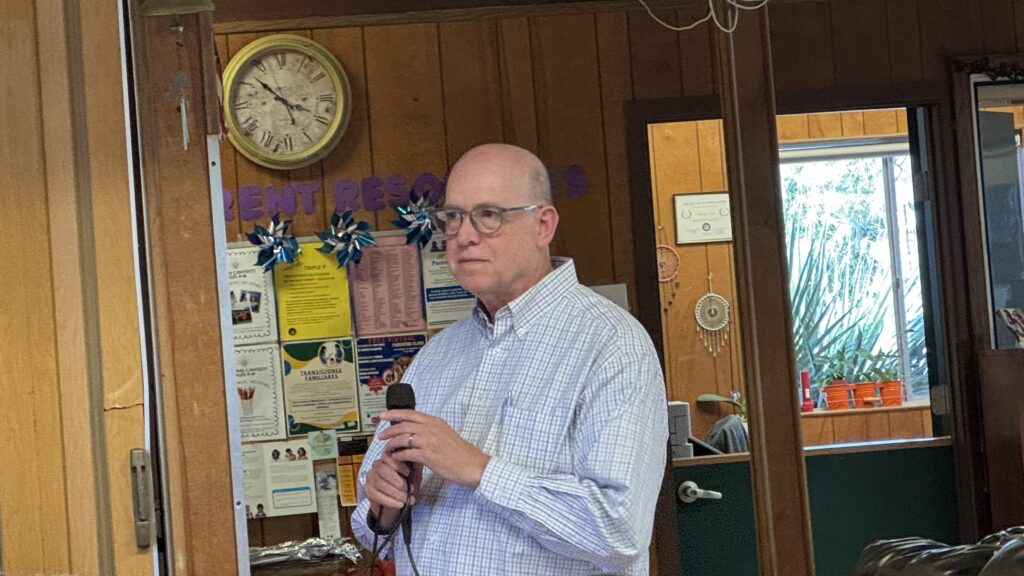
For David Fraser, Inyo County’s new County Administrative Officer, Tuesday’s meeting in Tecopa was his first trip to the southern end of the county he now helps administer — and by his own account, the view out the windows of the community center made an impression. The Mojave has a way of reorienting a person’s sense of scale, and Fraser, who came to the role in January following a competitive nationwide recruitment and a unanimous board vote, is still in the early months of acquainting himself with a county that is, by any measure, unlike most places a public administrator encounters in a career.
Fraser’s background is extensive. He arrives most recently from Adams County, Colorado, where he served as interim county manager, and before that as executive director of the Wyoming Association of Municipalities, city manager of Boulder City, Nevada, and administrator for municipalities in Kansas and Michigan. Over the course of his career he has supervised departments ranging from public works and airports to police, fire, public health, and human services, administered budgets as high as a billion dollars, and provided intergovernmental consultation to Fortune 500 companies. He holds a Master of Public Administration and a Bachelor of Arts in Political Science. The board approved his contract on February 3.
On Tuesday, Fraser presented the board with a straightforward personnel item — the hiring of Megan O’Keefe as the county’s new Assistant Treasurer-Tax Collector — and the board approved it without discussion. But his presence in Tecopa was itself a small piece of news: a new administrator, at the far end of a vast county, getting his first look at what governing this place actually means on the ground.
The Non-Profit Business of Governing a Remote Place
IMACA commodity deliveries to Southeast Inyo, which had been suspended, have been restored through funding arranged by the Eastern Sierra Education Foundation and supported by Southern California Edison. Supervisors Griffiths and Jennifer Roeser both serve on Edison’s Government Advisory Panel, which now meets bimonthly, and invited residents to submit service-related concerns directly to the county.
Community Advocates for Southeast Inyo — CASI — is in the process of incorporation, with Julie Finn serving as president and Shoshone’s Susan Sorrells, one of the region’s most rooted and recognized community figures, undertaking the work of founding it. The organization’s early focus, Sorrells reported to the supervisors, is practical and immediate: building relationships with food banks and nonprofits in Las Vegas and across Nevada, coordinating with IMACA, and improving food access for a community that sits closer to the Nevada border than to most of the institutions nominally responsible for serving it. Finn also reported that a community garden is currently in the design phase for Tecopa Francis Elementary — a small but tangible investment in the idea that this community can grow some of what it needs.
Supervisor Roeser also noted that a composting initiative is developing across Inyo and Mono counties, involving multiple nonprofits, and offered to connect CASI directly with the organizations driving it to support the community garden effort. The UC Cooperative Extension’s master gardener program, available through the Bishop office, could also be a meaningful resource, she added. Supervisor Griffiths agreed, noting that Southeast Inyo has largely been absent from those regional conversations — an absence, the subtext was clear, that CASI is now positioned to end.
Death Valley Unified School District Superintendent Jim Copeland noted in the night’s final public comment that the school board is open to discussions about repurposing the Tecopa Francis Elementary building for community and county uses, particularly to serve Charleston View residents — a fast-growing community he described as “the San Fernando Valley of Las Vegas” — who currently have virtually no access to county offices without traveling to Bishop. He also raised the cost of diesel fuel as the school district’s most pressing operational concern: 400 miles of bus routes per day, at prices he described as unprecedented.
In Brief
Clerk-Recorder Danielle Sexton, appearing by Zoom, announced that voter guides for the June 2026 primary are now available online. Beginning with this year’s guides, covers will feature local photography: the June guide will show a mountain bog photographed by assistant recorder Carolyn Mott; November’s guide will honor Southern Inyo. Next year, Sexton said, she plans to open the cover selection to a public amateur photo contest. In-person candidate filing assistance for the November election will be available in Tecopa on July 20 and at Furnace Creek on July 21.
The runway lights at Shoshone Airport are non-operational. The radio-activated control system that pilots use to key in and illuminate the runway has been inoperable, and the existing lights are mounted on non-breakaway poles — meaning an aircraft striking one would be diverted off the runway. A NOTAM has been filed with the FAA alerting pilots to the situation, and Road Maintenance Supervisor Shane Rily committed to following up on restoring the automated lighting system.
The High Sierra Energy Foundation will host a home energy efficiency workshop at the Hurlbut Rook Community Center on April 28, from 5:30 to 7:00 p.m., with dinner provided.
The Inyo County Board of Supervisors received Tecopa’s grievances with the practiced equanimity of a governing body that has spent enough Tuesday afternoons in this desert to know that it contains multitudes. A case in point: one resident opened his public comment — a request to place a container gym somewhere in the community — with a disclosure. “I’ve been coming here to Tecopa for a couple of years,” he said, “and noticed some witchcraft going on.”
At this point, if Tecopa’s communications don’t improve soon, witchcraft may be the most reliable option on the table.
The Inyo County Board of Supervisors will return to Tecopa in October.
Leave a Reply