
She left her husband alone at home with no way to call for help if the power goes out. That was the blunt, human accounting Tecopa resident Robin Flinchum offered to the Inyo County Board of Supervisors on Tuesday — a single sentence that distilled, with terrible clarity, what it means when a telecommunications giant is unable to serve its customers.
Flinchum’s landline is out. Her neighbor’s landline is out. Across Tecopa, Shoshone, and the surrounding desert communities of Southeast Inyo County, an increasing number of residents are discovering the same thing: AT&T, which holds a legal obligation as California’s carrier of last resort, is having trouble repairing its network when lines go down.
“As of this moment, I leave my medically fragile husband at home alone with no way to contact emergency services if something goes wrong,” Flinchum told the board at its semi-annual meeting held at the Hurlbut Rook Community Center. She had come not as a representative of the Southern Inyo Fire Protection District, where she serves on the board, but as a private citizen and a frightened spouse.
Copper in the Desert
Before examining the corporate and regulatory dimensions of the crisis, it is worth understanding the physical one — because in Southeast Inyo, the telephone network is being attacked from two directions at once.
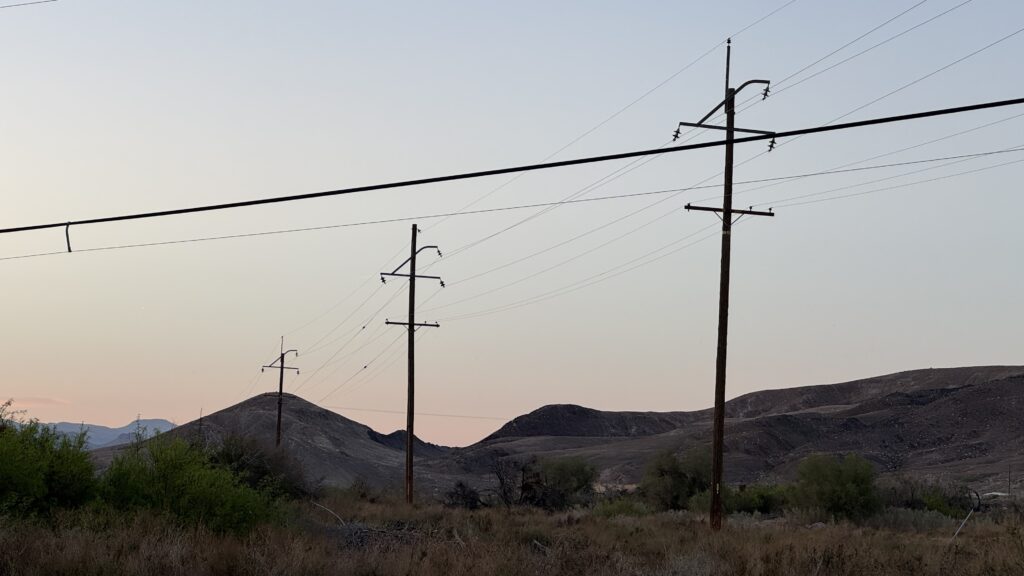
Shane Rily, Inyo County’s Road Maintenance Supervisor, told the board that the phone lines running between Shoshone and Tecopa have become a target for organized copper thieves who cut the cables, strip the metal, and sell it for scrap. The operation, he said, has the character of a coordinated campaign rather than isolated incidents. “I believe there’s an active investigation,” Rily said, “because some people came out and cut the phone line down from Shoshone to Tecopa. And when the service truck came out to fix the one section, they cut two more sections down and they replaced that. And then they were just out here last Wednesday and Thursday and they said they’d cut more phone lines down.”
The geography of the theft is sprawling. “They said it’s happening from Bakersfield all over,” Rily continued. “They’re going out in the desert and they’re just cutting the phone lines down and they’re scrapping them. So they’re having a problem getting a new line up before they steal it again.”
Lindsey Stine of the Inyo County Sheriff’s Office said: “An investigation is ongoing into incidents involving multiple sections of the same phone line being cut during nighttime hours. Based on information gathered so far, this does not appear to be isolated to our area, and similar activity has been reported elsewhere in Southern California. We are coordinating with AT&T and the Bureau of Land Management as part of the investigation. At this time, impacts appear to be limited. To our knowledge, only one resident has been directly affected by a service disruption and has since implemented alternative communication methods. Most residents in the area appear to still have access to Wi-Fi and are able to contact 911 in an emergency. No additional service issues have been reported to us at this time. We ask the public to remain aware of any unusual activity, particularly vehicles in remote areas near utility lines during nighttime hours that do not appear to be associated with utility or official personnel.”
AT&T responded: “We’re working to restore service for customers affected by ongoing copper theft activity at this location. We’re actively working on restoration efforts and will complete repairs as soon as possible. We apologize for the disruption and appreciate our customers’ patience as this work continues. We recognize the important role communications services play, and we remain committed to maintaining reliable, high-quality service for our customers. Theft and vandalism of critical communications infrastructure are serious criminal matters that can disrupt service for customers and the surrounding community. We are in contact with local law enforcement regarding the ongoing thefts at this location.”
What AT&T did not address is the gap at the center of Tuesday’s testimony. TecopaCabana followed up with two pointed questions: whether the company intends to address the preexisting service issues around landlines in Tecopa that predate the copper theft, and — given that law enforcement says the vandalism has affected only one customer — how AT&T accounts for all the other residents who testified to service disruptions. The company did not respond.
AT&T has publicly acknowledged the severity of copper theft as a national infrastructure problem. In a fact sheet the company distributes on the subject, it characterizes such theft as a matter of critical public safety — one that can disconnect hospitals, community clinics, and police stations, put lives at risk, interrupt government services, and endanger the repair crews sent to fix the damage. The company notes that when thieves face little fear of punishment, they grow emboldened, driving up the frequency and cost of repairs. It says it works actively with law enforcement to investigate and pursue those responsible.
AT&T also makes a point in that document that carries particular resonance in the context of Southeast Inyo: constant repair of damaged legacy copper infrastructure, the company argues, delays the deployment of new technology like fiber. It is a real operational burden. Repair crews dispatched to replace cable that will be cut again the following week are crews not building the next generation of network.
The copper theft crisis is, in other words, genuine — and AT&T is not wrong to flag it. But in Southeast Inyo, it lands inside a context the company’s fact sheet does not address: a community that has no cell service or fiber coming, and whose residents depend on a patchwork of workarounds — a mesh internet service relayed from Las Vegas, and satellite-based Starlink where residents can afford it and manage the setup.
Starlink has proven a genuinely reliable alternative in this terrain, particularly when paired with a backup power bank that keeps it running during the region’s frequent electricity outages. For those who can get it working, it represents something close to a real solution. But that qualification carries significant weight in a community where many residents are simultaneously elderly, financially stretched, and — as Tuesday’s testimony made plain — struggling to get their existing phone to connect to WiFi in the first place. The Starlink hardware runs several hundred dollars upfront. The monthly subscription adds to that. And configuring satellite internet with backup power, WiFi calling, and device compatibility is a technical undertaking that presupposes a degree of comfort with technology that cannot be assumed across a population that includes people in their seventies, eighties, and beyond who simply need their landline to work.
A Legal Obligation, Quietly Ignored
To understand why the telephone crisis in Southeast Inyo has reached this point, it is necessary to understand the legal architecture that was supposed to prevent it — and the sustained effort to dismantle that architecture.
AT&T holds the designation of carrier of last resort, or COLR, under California law. The status exists for a reason that is simple and consequential: in remote, sparsely populated areas, no private company would choose to build and maintain telephone infrastructure if left entirely to market forces. The economics don’t work. The carrier-of-last-resort framework was designed to ensure that those communities receive basic telephone service anyway, by assigning the obligation to a carrier and making it a condition of doing business in the state. It is, at its core, a social contract — one that AT&T accepted as part of its operating license.
For several years, AT&T has been trying to renegotiate that contract unilaterally. Assembly Bill 470, introduced in the California Legislature in 2025, would have allowed AT&T to be formally released from its COLR obligations — the legal equivalent of tearing up the agreement and walking away. The bill would have permitted AT&T to discontinue landline service in any area it deemed sufficiently served by wireless or broadband alternatives, a standard the company’s own lobbyists would have had considerable influence in defining. In practice, it would have given AT&T the authority to declare communities like Tecopa adequately served — and exit. The bill’s defeat was not a foregone conclusion. Inyo County Supervisor Jeff Griffiths traveled to Sacramento to oppose it and was present at the hearings where its fate was decided. It drew opposition from disability advocates, rural county supervisors, and consumer protection groups before ultimately being shelved. “We were able to defeat that,” Griffiths told the Tecopa meeting. The obligation, for now, remains on the books.
But the defeat of AB 470 resolved the legal question without resolving the practical one. The bill would have let AT&T leave openly. Having lost that fight, the company must continue to provide service.
Flinchum traced the gap between AT&T’s public statements: in April 2025, the company’s Vice President of Legislative Affairs told a legislative hearing that no Californian would be left without basic phone service in their home, including 911 access. In May 2025, AT&T told regulators it was seeking relief only in areas already well-served by broadband and wireless alternatives — and that for areas without those alternatives, it remained committed to continued service. Southeast Inyo County, with its sparse broadband and nonexistent cell coverage, falls squarely into the category AT&T said it would continue to serve.
The Shape of Abandonment
Toni Kizzia’s phone went out on March 25. “I mean, they tortured this old lady for 20 hours. And to me, that’s unconscionable.” In the three weeks that followed her outage, she estimated she spent no fewer than twenty hours on hold, being transferred, waiting for callbacks that never came, and waiting at home for technicians who never arrived. One representative called to tell her a repair crew would be at her door in fifteen minutes. She waited, missing a memorial service for a friend, while the technician never appeared. Her phone remained dead. Her automatic bill payment, meanwhile, continued to pull money from her checking account for a service she was not receiving.
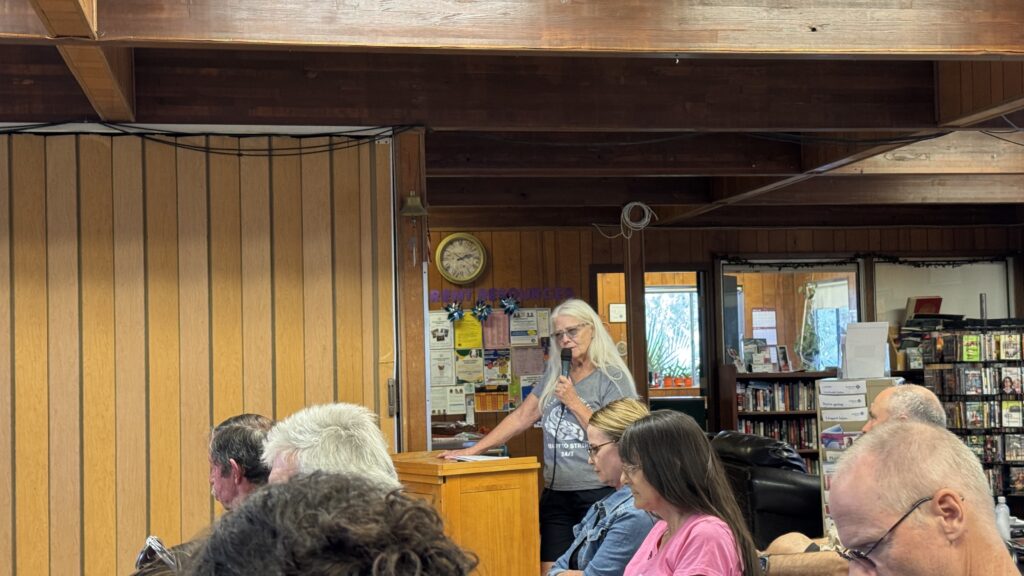
“I’m pushing 70, my husband is pushing 80,” Kizzia told the supervisors. “911 is really important to us.” Her voice carried not just frustration but exhaustion — the particular exhaustion of someone who has done everything right and still lost.
The experience she described is not unique. It has a structure, residents said, that feels less like a series of individual failures and more like a policy. Call AT&T. Be placed on hold. Be transferred. Be placed on hold again. Be told a technician is coming. The technician doesn’t come. Call back. Repeat.
“It’s a big circle. They say go online and report your outage. You go online and they say you can’t report an outage for a landline. So call the number. They put you on hold. Then they transfer you. Then the next guy puts you on hold. It’s an obvious way to escape the complaining and just pass the buck.”
When AT&T did offer a solution, it was always the same one: abandon the landline and switch to AT&T Wireless. The irony, residents noted, is sharp. In a region where cell coverage is sparse, and in some places entirely absent, AT&T’s answer to a failed landline is a cell phone on AT&T’s own network. “Why would I want AT&T Wireless when they can’t even get a landline to work?” Kizzia asked.
Steve McNeal, owner of Death Valley Hot Springs, described a two-year odyssey that began when AT&T introduced static onto his line and offered him a cell phone as a replacement. “I said the cell phone won’t work out here,” he recalled. “They said, oh yeah, it will. It didn’t.” WiFi calling was not a workable backup for him because he works on a 40-acre property where service drops off about 100 feet from the router.
“I Got Beat”
Of all the testimonies offered Tuesday, Billy Eichenbaum’s was perhaps the most methodical. An EMT and volunteer firefighter with the Southern Inyo Fire Protection District who has lived in the area for 28 years, Eichenbaum spent three months getting up each morning and spending six or seven hours on the phone with AT&T. His goal was straightforward: transfer his landline from one address to another. The line was critical not just for personal use but because it served as the fire department’s most reliable means of receiving dispatch calls when radio communications failed.
He was transferred between departments. He was made promises. After three months, he received a final answer: AT&T could not transfer a landline from one location to another, even when the destination address had previously had a landline. No one could explain why.
“I didn’t want to be beat,” Eichenbaum said. “I got beat.”
He addressed the supervisors directly and without softness: the phone numbers and regulatory avenues they might suggest, he had already tried. All of them. “I guarantee the phone numbers you gave out and the avenues you gave, I did, and nothing happened.” What it would take, he said, was for one of the supervisors to find an AT&T executive and have a conversation at a level of power that the residents of Tecopa simply do not possess. “If I knew where an AT&T executive was, I would go there and either get arrested or solve the problem.”
What the Board Can Do
Supervisor Griffiths directed residents to the California Public Utilities Commission. Complaints can be filed by internet or phone (details below). He noted that the volume of individual customer complaints carries genuine regulatory weight. “I don’t believe there’s any limit to the number of complaints you can make,” he said.
The board indicated it would consider writing a formal letter to the CPUC and to Inyo County’s state senator and assembly member. Flinchum formally requested that the board adopt a resolution insisting AT&T honor its carrier-of-last-resort obligations.
It is worth noting, however, that regulatory pressure has its limits — and those limits are structural. For a company of AT&T’s scale, the fine for non-compliance will almost always be less than the cost of actual compliance. The CPUC can pressure, investigate, and penalize. What it cannot easily do is force a trillion-dollar corporation to invest in infrastructure.
Larry Levy, another SIFPD firefighter, proposed a pointed tactical suggestion: whenever anyone speaks with an AT&T representative, make them pull up a map first. “They don’t know where you’re calling from,” he said. When a representative promises to have someone out the next day, they may be imagining a suburb. Looking at a map of the Mojave changes the conversation.
What Is at Stake
The telephone, in the cities and suburbs where most Californians live, has long since become a secondary device — one option among many, easily replaced by a cell phone or an internet-based alternative. In Southeast Inyo County, it remains something more fundamental. The region has unreliable cellular service at best. It has frequent power outages. And it has a population that skews older, more isolated, and more medically vulnerable than most of California.
Mandi Campbell of the Timbisha Shoshone tribe described residents of Death Valley’s Indian Village being denied new landline installations — including for a 102-year-old elder whose caregivers have no reliable way to summon help during the night. The image is not metaphorical. It is a description of what it looks like when infrastructure policy, corporate strategy, and geography converge in a place that the rest of California rarely thinks about.
AT&T’s own fact sheet on copper theft warns solemnly that when critical communications infrastructure is compromised, people’s lives are at risk. Hospitals lose connectivity. Emergency services are disrupted. The company is not wrong. In Southeast Inyo, residents would simply note that the infrastructure was already failing — and that the company which published that warning is the same one that has been sending them in circles for months.
The supervisors ended their meeting on Tuesday without a resolution passed, without a letter sent, without a commitment extracted from AT&T. What they carried with them was the testimony — the 20 hours on hold, the technician who never came, the husband left alone without a way to call for help if the power goes out, the EMT who spent three months and got beat. Whether that testimony translates into action, or joins the long archive of grievances this region has presented to successive generations of officials, remains to be seen.
The phones, for now, remain out.
The Inyo County Board of Supervisors meets next in Tecopa in October. CPUC landline complaints: cpuc.ca.gov | 1-800-649-7570
This article is based on public testimony delivered at the April 14, 2026 Inyo County Board of Supervisors meeting.
Updated April 22, 2026 to include statements from Inyo County Sheriff and AT&T.
Leave a Reply