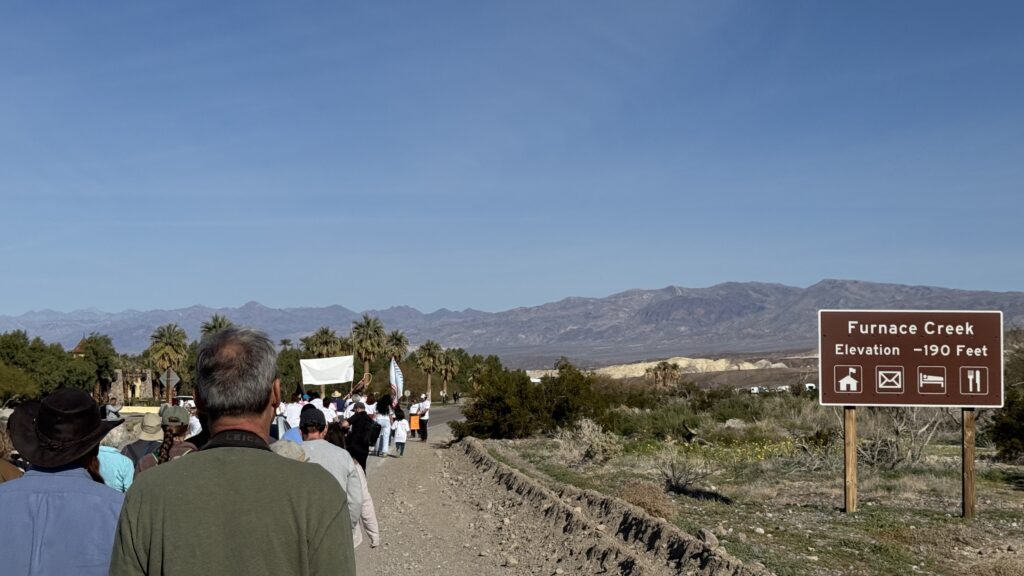
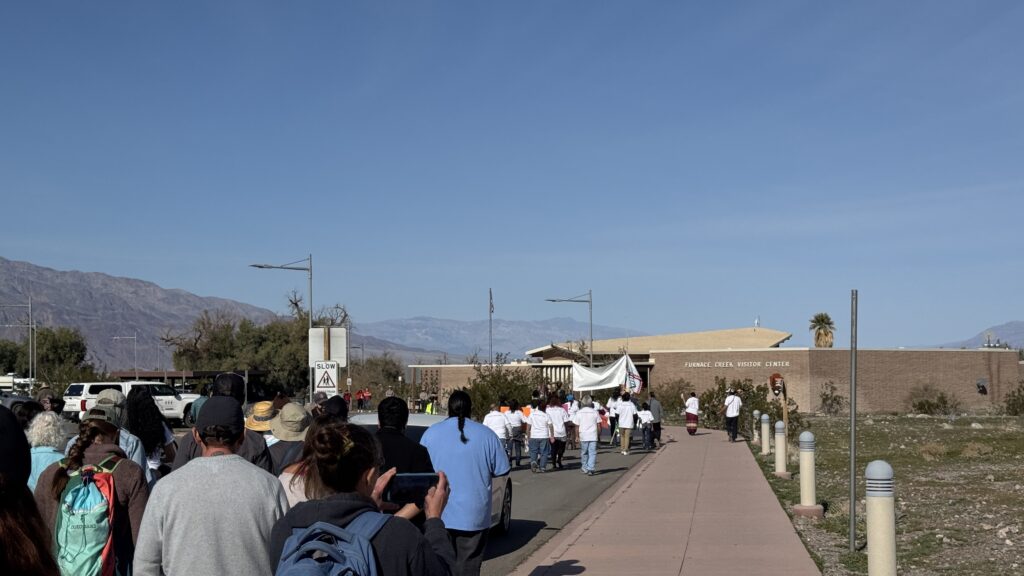
On a clear late-January morning at Furnace Creek in Death Valley National Park, the visitor center felt less like a museum lobby than a civic hall.
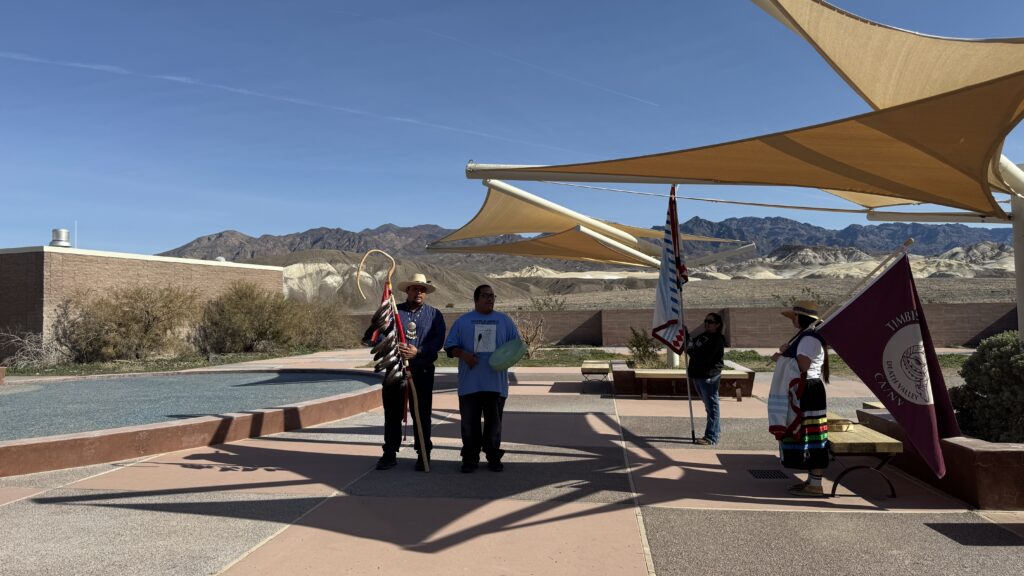
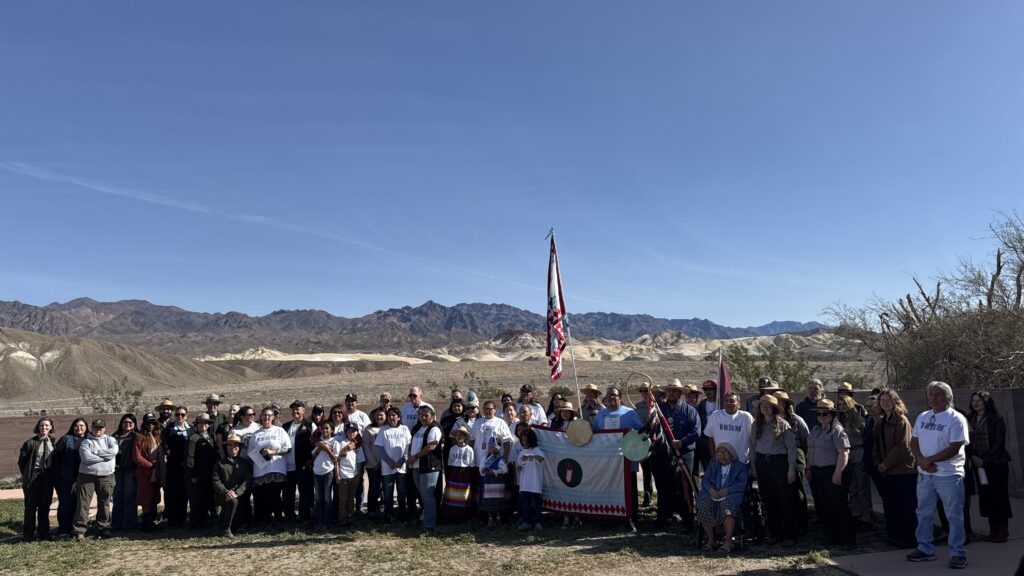
The packed auditorium seating, usually for visitors watching an interpretive film, faced a ring of seats, filled with the leaders and elders of the Timbisha Shoshone Tribe. Upon arrival from marching from their nearby village to the center, they invited the crowd to open with prayer. The occasion was formal—the 25th anniversary of the Timbisha Shoshone Homeland Act of 2000—but what unfolded was not a nostalgic ceremony. It was a public stock-taking of how that law came to be, what it did, and what remains unfinished.
What the Homeland Act Is
The Timbisha Shoshone Homeland Act—Public Law 106-423, signed November 1, 2000—did something no federal statute had done before: it took land out of a national park and made it part of a reservation for the Timbisha Shoshone.
Congress began by putting in writing what Timbisha people had asserted for generations. Since time immemorial, the Tribe has lived in what is now eastern California and western Nevada; their ancestral homeland explicitly includes the area now called Death Valley National Park, as well as surrounding Bureau of Land Management lands.
Since 1936, they had lived on about forty acres near Furnace Creek under a makeshift “Indian village” arrangement, gained federal recognition as a tribe in 1983, and yet still had no formal land base in their own homeland.
The Homeland Act creates specific trust parcels in and around Death Valley—at Furnace Creek, Death Valley Junction, Centennial, Scotty’s Junction, and Lida—to be held by the United States for the Timbisha Shoshone. It sets aside a 313.99-acre trust parcel at Furnace Creek for housing, a tribal community center, and limited visitor-oriented development, including a small desert inn and a tribal museum and cultural center with a gift shop, along with the infrastructure those uses require. It designates “Natural and Cultural Preservation” and buffer areas where the Tribe is guaranteed access for traditional and religious activities, where the Park Service must limit visitor use to protect privacy, and where ceremonies can be temporarily shielded from public view. The Act also requires government-to-government consultation and cooperative agreements on planning, development, and resource protection, with jointly agreed standards for environmental sustainability and water monitoring. Finally, it confirms that Timbisha members may enter and use Death Valley National Park without paying an entrance fee, and that all of these trust parcels together constitute the Timbisha Shoshone Reservation, governed under the same laws as other Indian trust lands.
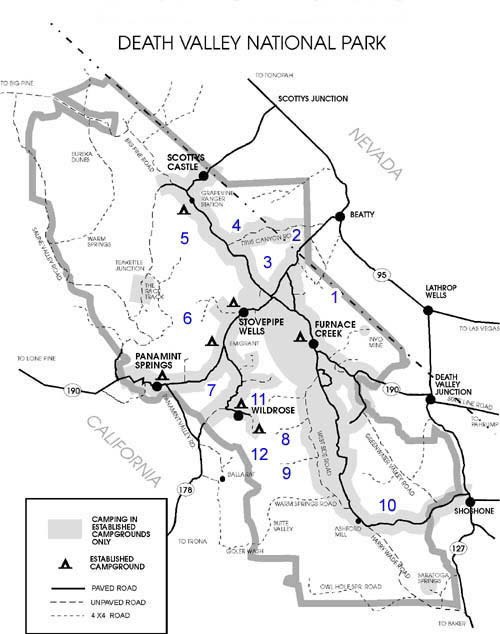
Water is written in as the homeland’s lifeblood, not an accessory. Each trust parcel carries a defined allocation—up to 92 acre-feet per year at Furnace Creek, 15.1 at Death Valley Junction, up to 10 at Centennial (with a required substitute if groundwater is inadequate), 375.5 at Scotty’s Junction, and 14.7 at the Lida community parcel—so that the land base comes with usable supplies. All associated Federal water rights share a November 1, 2000 priority date, are junior to existing Federal and State rights, and are expressly protected from loss by non-use, relinquishment, forfeiture, or abandonment. The Act also authorizes acquiring additional lands “and appurtenant water rights” into trust and requires the Tribe and Park Service to jointly monitor pumping at Death Valley Junction and Scotty’s Junction, tying the legal homeland to ongoing shared oversight of the aquifers beneath it.
Congress’ stated purposes were blunt: to provide a permanent land base within the Tribe’s aboriginal homeland and to enhance both the Tribe’s and the National Park Service’s interests through coexistence, partnership, and more honest interpretation of Timbisha history and culture for visitors.
How the Act Came to Be
The Homeland Act was not a gift from Washington; it was the hard-won endpoint of a 65-year struggle that began when Death Valley was first carved out of Timbisha homeland and set aside as a federal monument. In 1933, Death Valley National Monument was created. By 1936, the Bureau of Indian Affairs and the National Park Service had agreed to set up a small “colony” for Timbisha people at Furnace Creek—an arrangement that acknowledged their presence but never conceded ownership. Two decades later, in 1957, the Park Service imposed an “Indian Village Housing Policy” that tightened federal control over even that tiny village. Through the 1970s and 1980s, the Timbisha Shoshone fought for federal recognition and marginal improvements in housing while remaining confined to a few acres inside a tourist landscape built on their own homeland.
The modern homeland campaign took shape in the early 1990s. In 1993, the park hosted a meeting with the Tribe on land restoration, and that July the Tribal Council formally committed to pursuing a legislative “homeland restoration” package. The following year, Congress passed the California Desert Protection Act, elevating Death Valley to national park status and, in Section 705(b), ordering a formal study of the Timbisha land situation. What followed was a first round of homeland negotiations: large working-group meetings through 1995 and a draft Secretarial report by that November. Then the process broke. In early 1996, federal negotiators met in Washington without tribal participation; when the parties reconvened at Cow Creek in March, the Tribe walked out, later charging that the study was being twisted into a vehicle to push Timbisha out of the park rather than secure their place within it. That breach sparked a season of protest and political organizing. In May 1996, the Tribe and Greenpeace led a march at Death Valley; later that year, the Tribe wrote directly to President Clinton and helped form the Alliance to Protect Native Americans in National Parks. Historian Theodore Catton notes that by the mid-1990s, Timbisha leaders were explicitly invoking “ethnic cleansing” and “cultural genocide,” arguing that a people without a land base in their own homeland were being slowly erased. Furnace Creek, one member said, was their Sarajevo.
A second, more productive round began when Interior officials chose to re-engage. In 1997, Assistant Secretary for Fish and Wildlife and Parks Don Barry decided to reopen the effort. In January 1998, a tribal delegation met with him and other federal officials in Washington; later that month, negotiations resumed on the ground at Death Valley. By April 1999, Interior had produced The Timbisha Shoshone Tribal Homeland – A Draft Secretarial Report to Congress, sketching a blueprint for a land base and cooperative management. On November 10, 1999, Senator Daniel Inouye asked Interior to translate that blueprint into a bill. The Senate Committee on Indian Affairs held a hearing in March 2000; the Senate passed the measure in July; the House followed in October; and President Clinton signed it on November 1, 2000. As the Administrative History later put it, the Homeland Act “marked the culmination of a 65-year struggle” to secure a permanent home in Death Valley and to remove what a Senate committee called the “major barrier” to the Tribe’s social, economic, and political advancement: being landless in their own country. Against that backdrop, the anniversary gathering at Furnace Creek was never just commemorative. It was a reckoning: after all of that, what exactly did the law deliver—and how well are we using it now?
Inside the Anniversary Gathering
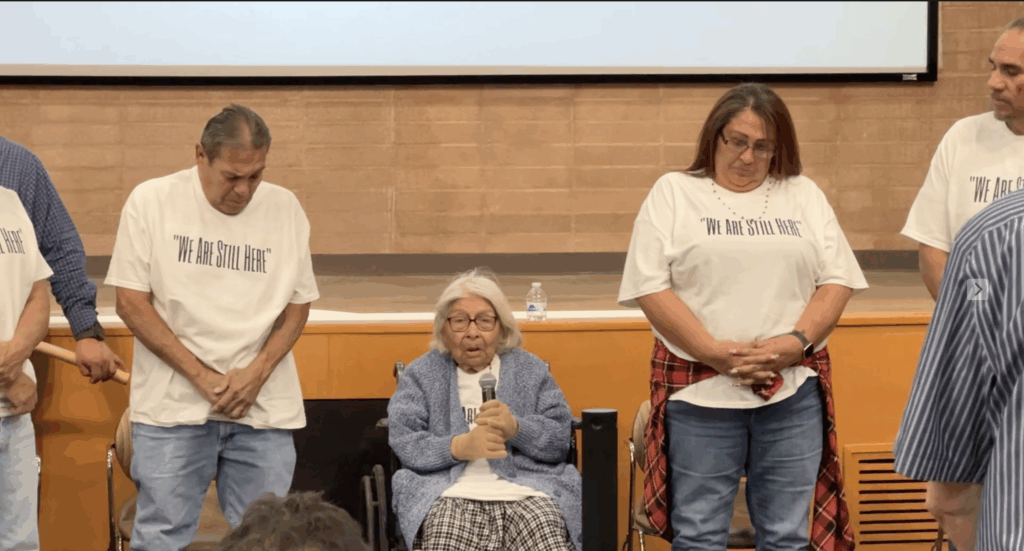
The program at Furnace Creek was laid out like any official event: welcome, blessing, remarks, a panel, photos, and cake. But once the elder Pauline Esteves, 101, finished the opening prayers and the first speakers took the microphone, it became clear that this was a live conversation about power, memory, and responsibility, not just a scripted celebration.
Park Leadership: “A Watershed Moment”
Superintendent Mike Reynolds opened by welcoming people to the Furnace Creek Visitor Center and naming the significance head-on: twenty-five years earlier, Congress passed one of the most foundational pieces of legislation affecting a Native nation inside a national park. Achieving consensus on a bill that transferred nearly 7,800 acres of federally managed land—including about 314 acres right there at Furnace Creek—into tribal trust, while also committing the National Park Service and the Tribe to collaborative management, had not been easy. The relationship between the National Park Service (NPS) and the Timbisha had often been a source of tension, not celebration.
What changed, he suggested, was not just the law on paper but the practice of working together in its wake. Since 2000, park and tribal staff have collaborated on conservation projects, visitor education, and the sharing of traditional ecological knowledge and current conditions—finding ways to tell “the many stories” of this place, not just a single, park-centric narrative.
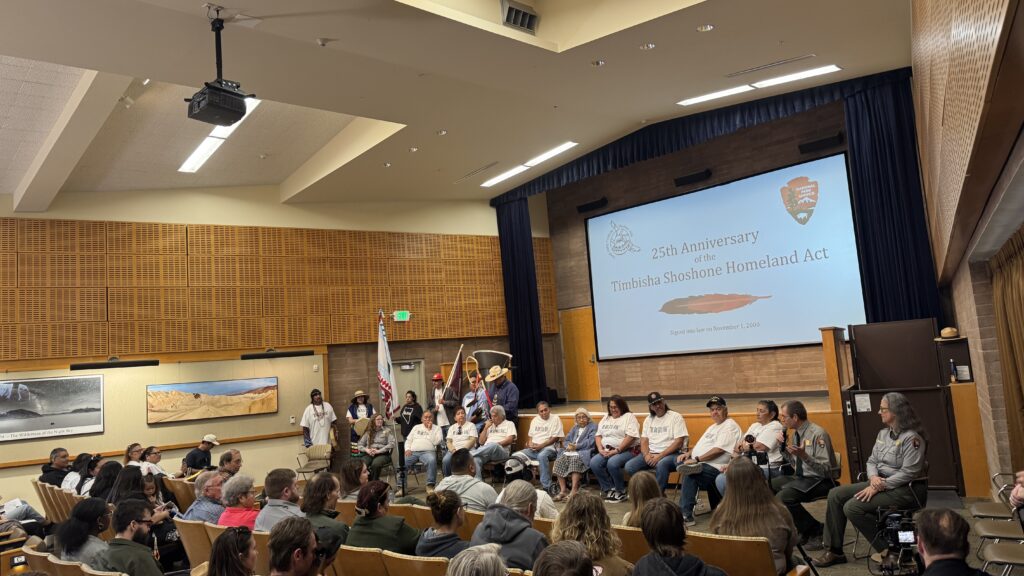
Reynolds pointed to a line of people whose names sit in the statute’s legislative history: Esteves, Barbara Durham, Grace Goad, Richard Boland, “Spike” Jackson, Dale Hansen-Johnson, Joe Kennedy on the Timbisha side; and John Reynolds (regional director), Dick Martin (former superintendent), Pat Parker, Don Barry and others on the federal side.
Each, he said, had a part in bringing the Act into being. You can read the law, he reminded the room, but it will never convey the labor it took to get those few pages of text.
In 1999, John Reynolds wrote in the preface of his report to Congress, “If we resolve to make a better nation for our children, a nation that recognizes the promises of America’s best ideas and is not bound to the thought that the decisions of the past are the best that we can do, then we have a unique opportunity to rectify the existing situation where the Tribe lives on its ancestral lands without the ability to achieve self-determination and economic independence.”
The current superintendent also stressed something that ran through the entire event: trust is not automatic. It has to be built, maintained, and constantly renewed in day-to-day work—from consultation with the Tribal Historic Preservation Officer and the Heritage Preservation Committee to long-term planning with the Tribal Council. Partnership is not self-executing; it depends on people showing up and being willing to do things differently.
Tribal Council: From Invisibility to Being “On the Map”
When Chairperson Margaret Cortez and other members of the Timbisha Shoshone Tribal Council spoke, they pulled the story down to the scale of homes, families, and daily experience.
Cortez thanked the crowd for coming and noted that this gathering “should have happened three months ago,” but the delay didn’t lessen its importance. She reminded people that “Death Valley” is one part of a larger homeland that includes other parcels—places like Death Valley Junction and Lida—that the Tribe still visits and protects. The Homeland Act may be rooted in one valley, but it recognized a network of homelands.
Before 2000, said George Gholson, Timbisha Secretary/Treasurer, the Tribe was treated as if it were squatting on park land—regulated, vulnerable, and always at risk of erasure. Houses were demolished or washed away; people returned from seasonal work to find structures gone. Council members asked the audience to imagine going home and discovering that your house simply did not exist, and you had no citizenship rights.
The Homeland Act meant the Timbisha were no longer invisible. It put them “on the map” in a way that federal agencies and local law enforcement could not ignore. But it did not end struggle. Tribes remain underfunded and still face jurisdictional tangles on their lands. Everything a tribe does is still a battle. The law was monumental because it changed the terrain of that battle; it didn’t erase it.
The elders who had not lived to see the anniversary were honored and put responsibility on those in the room to move the Tribe forward in their name. The climate itself became part of the testimony—how punishing Death Valley summers are, how astounding it is that people have lived in this landscape for millennia, and how much respect is owed to those who stayed when others would have left.
“We Should Be an Example”: Partnership as Model
Council members spoke plainly about wanting this event to have started 25 years ago, as an annual tradition. Another underscored how unusual Timbisha’s situation is in the broader Indian Country context: most tribes with national park homelands are still fighting either for recognition, land, or basic respect. Here, at least, there is a legal land base and an established working relationship—imperfect, but real. They want that to become a model for others.
That model, they stressed, needs to be strengthened in writing. Several speakers distinguished between a loosely worded “stewardship agreement” and a robust co-management agreement—a document strong enough to take back to Congress, clear enough to survive changes in park and tribal leadership, and specific enough to remove fear and guesswork about what co-management actually means in practice.
Jimmy-John Thompson, Timbisha Council Member, also recited concrete promises still outstanding in the law itself. The Homeland Act envisions up to 50 homes in the village; they want to see that fully built out. It authorizes economic development and cultural facilities at Furnace Creek; he reported securing $1.2 million to start construction of a tribal museum, necessary not only for visitors but to house cultural items now frequently being repatriated from universities and museums. That museum, he said, will require help—donations, partnerships, and a sustained commitment to interpret the place through Timbisha eyes.
Mandi Lynn Campbell, the Tribal Historic Preservation Officer, turned to the courtyard outside and the land beyond and reminded everyone that this is more than a ceremonial backdrop. It is an active food and medicine landscape, a place of “healing gardens” and children’s futures, where traditional ecological knowledge and contemporary science can and should work together.
Former Superintendent J.T. Reynolds: A Federal Insider Reflects
Among the speakers was an impromptu contribution by J.T. Reynolds, who served as Superintendent of Death Valley National Park from 2001 to 2009, stepping into the role just after the Act became law. An abundance of Reynolds have worked in the park system, apparently, and he has no relation to the regional director John, or the current superintendent, Mike, but called him a “cousin” nonetheless.
He spoke not only as a former park manager but as someone who had spent a career inside the National Park Service wrestling with its history with Native nations.
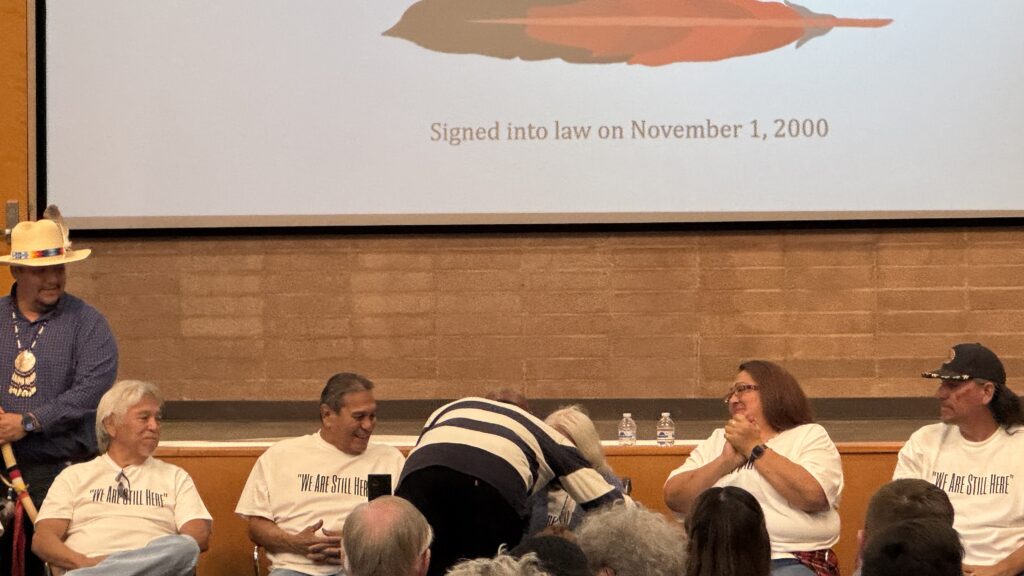
He reminded the room that what happened at Death Valley—the demolition of adobe homes when people went to higher elevations in summer, the pressure to move tribal communities out of parks—was part of a larger pattern across the NPS system. As a federal official, he said, you have to admit that the government has done “dastardly” things to Native peoples, here and at places like Grand Canyon. The important thing, in his view, is to own that history and build relationships that are the opposite: grounded in honesty, dignity, and respect.
He described working with Timbisha elders who insisted on prayer before difficult meetings, who spoke of rocks and places as alive. Those practices were not symbolic; they shaped decisions—like whether to push a road through a sensitive canyon or reroute it at additional cost. He was blunt about standards for his own staff: if you cannot do this work with integrity and respect for the Tribe, you shouldn’t be here.
His presence at the anniversary drew a line back to the immediate post-Act years, when the ink was dry but everything about how to implement it was still being invented day by day.
Partners, Staff, and the Work of Making Law Real
The “time to share” panel brought in a wider circle and together they sketched what the Homeland Act looks like when translated into daily practice.
From the tribal side, one of the strongest themes was trust: trust that park staff will not betray confidential cultural information; trust that when the Tribe says a place is sacred or sensitive, plans will adjust; trust that the Tribe will be consulted early rather than as an afterthought. One panelist recalled how, in the early years, there was mutual hesitation—tribal representatives weren’t sure how much to reveal, and some park staff worried that involving the Tribe would complicate projects. Over time, as consultation became embedded and staff learned to ask first instead of last, that dynamic shifted.
Park staff echoed this. One official spoke about repeated “thousand-year” floods and the need to rebuild roads and facilities. The old institutional reflex was to put things back where they were as quickly as possible. The newer pattern, they said, is slower and more deliberate: consult with the Tribe before designs are finalized, consider alternate alignments, and accept that what looks like an engineering problem is also a cultural one. The Homeland Act’s requirement for jointly developed standards and special-use management plans gave them both a legal and moral framework to say “yes” to tribal concerns, not just “we’ll see.”
A representative from the Native American Heritage Commission described how state-level tools, like confidential listings of sacred sites, can be used upstream in planning so that road projects or other developments trigger red flags before money is spent and damage is done. She offered the Commission’s help explicitly, tying it back to the Act’s spirit of government-to-government coordination.
Infrastructure came up, too, in a very different sense. Repeatedly Tribal members mentioned their need for broadband and fiber internet for the community. In a valley where even email can disappear into the ether, basic communication infrastructure is an emergency-preparedness issue and a prerequisite for effective co-management, not a luxury.
Looking Ahead: Co-Management, Interpretation, and Continuity
A final question to the panel—what are you most looking forward to working on together?—pulled the conversation toward the future.
Some answers were technical: completing a true co-management agreement; finishing housing and community facilities envisioned in the law; expanding joint resource management in canyons, springs, and wildlife habitats. Others were personal: Reynolds, the current superintendent who hikes a different canyon every week, spoke of wanting to understand the land through Timbisha stories, not just maps and trail guides.
Several speakers returned to interpretation. They want visitors to stop treating viewpoints and trailheads as mere backdrops for selfies, and instead understand what they’re looking at: trails traveled for a thousand years, vegetation that is food and medicine, rock features that show signs of human presence and care. Signs, exhibits, and ranger talks should reflect that.
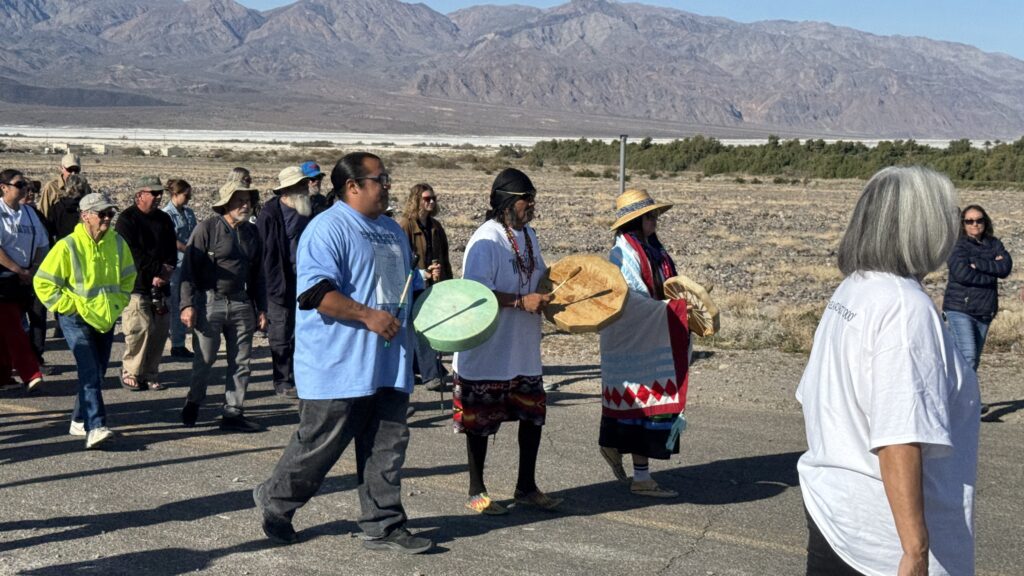
There was also a quieter but insistent thread about cultural continuity. One elder, Jeremiah Jones, who traveled from Elko, Nevada to perform on the march to Furnace Creek, raised the issue of songs—who will carry them, who will be “keepers of the song,” and how that responsibility will pass to younger generations. Law can transfer acres and formalize consultation; it cannot, on its own, keep a language or a song alive. That, they implied, is the community’s work, supported—but not substituted—by institutions like the Park Service.
Closing: An Anniversary Without Illusions
At the end of the program, the moderator thanked everyone, reminded them that printed copies of the Homeland Act were available, and invited the crowd out through the sliding glass doors to the courtyard. There were photos to take and cake to cut. It looked, for a moment, like any other anniversary.
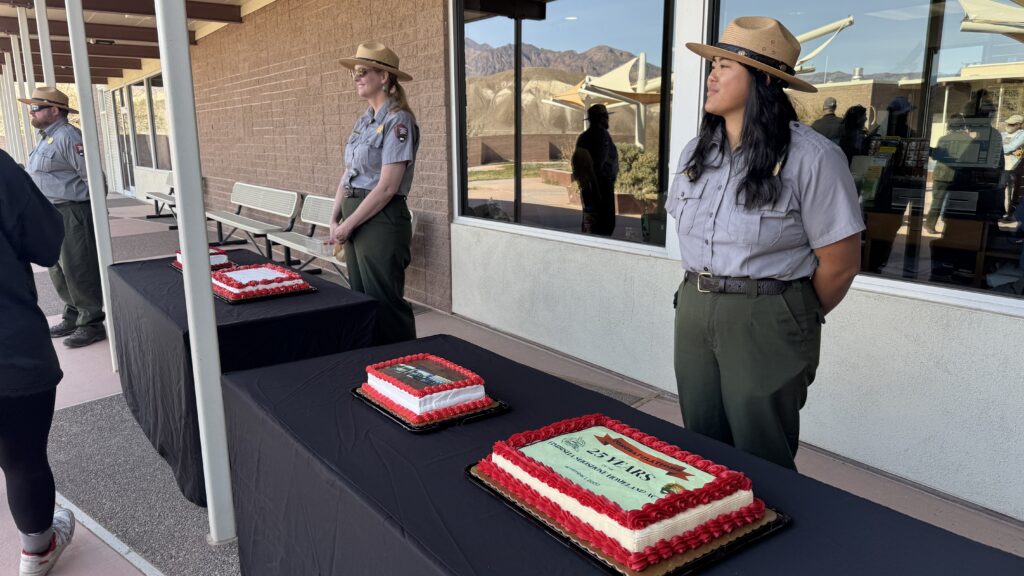
But the substance of the morning resisted easy closure. Speakers had honored elders and negotiators, acknowledged the law’s precedent-setting significance, and then spent most of their time on what remains undone: homes not yet built, a museum and cultural center just beginning to take shape, a co-management agreement still to be written, broadband still missing, songs that must be passed on.
In that sense, the event was truer to the Act’s own character than a purely celebratory gathering would have been. The Homeland Act did not arrive as a gift; it was won through protest, negotiation, and a willingness by both the Tribe and some federal officials to risk doing something new inside the national park system.
Twenty-five years later, the people gathered at Furnace Creek treated it not as a finished monument but as a tool—one they intend to keep using until the idea of “homeland” is visible not only in the pages of the U.S. Statutes at Large, but in the houses, institutions, relationships, and stories that shape life in Death Valley every day.
Leave a Reply