
Fencing, nursery-grown outplantings, and new interpretive signage aim to curb vehicle damage and revive a declining niterwort population in the Tecopa Hot Springs area.
On the evening of February 18, 2026, the Tecopa Community Center became a briefing room for a plant most visitors never notice—because it’s only a couple inches tall, blends into crusted salt flats, and lives in a place that can look, at first glance, like “hardly any vegetation.”
But that invisibility is part of the problem.
Amargosa Conservancy staff and partners gathered with residents to outline a new, experimental restoration effort for the endangered Amargosa niterwort—an endemic species found only in the Amargosa Basin—focused on habitat near the miner’s tub or wild pool and the warm springs off Furnace Creek Road in Tecopa Hot Springs. The goal is straightforward: keep vehicles out of sensitive wetlands, stabilize and rebuild the plant population, and use education and cultural context to shift how people treat the area.
“This is a highly experimental restoration,” Mason Voehl, director of the Conservancy, told the group, describing the project as one piece of a larger, grant-funded suite of work planned across the region over the next several years.
A broader grant, a local flashpoint
The meeting opened with introductions from new Conservancy leadership: Clare Throm, deputy director, and Holly Fischer, Restoration Project Manager. They framed the Tecopa effort as part of a four-year grant secured with California Botanic Garden through the California Wildlife Conservation Board, a state agency that funds restoration work across California.
While the niterwort restoration was the headline for Tecopa, presenters described a larger package of projects under the same grant umbrella:
- Seed collection and conservation banking over multiple years, including dozens of collections for both common and rare species across the Amargosa.
- A cultural seed banking program developed with the Timbisha Shoshone Tribe to identify and preserve plants of cultural importance, with an emphasis on long-term access and stewardship.
- Expanded plant inventory work—essentially building a clearer, science-backed record of what grows where in the Amargosa, and what’s changing.
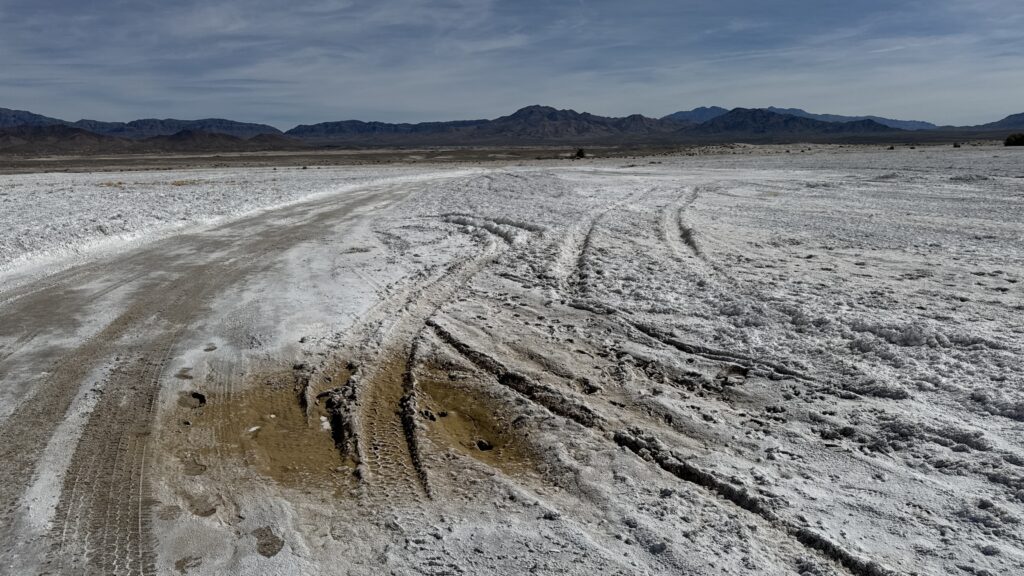
The niterwort, however, is where the grant’s ambitions meet the ground-level realities of Tecopa Hot Springs: tourists following social media pins, cars cutting new tracks across a flat, and recreation colliding with fragile habitat and shallow groundwater.
“There’s no education, there’s no information, no signage”
Dr. Naomi Fraga, Director of Conservation Programs at California Botanic Garden, led the technical explanation of why the Tecopa site is urgent—and why it can be damaged so easily.
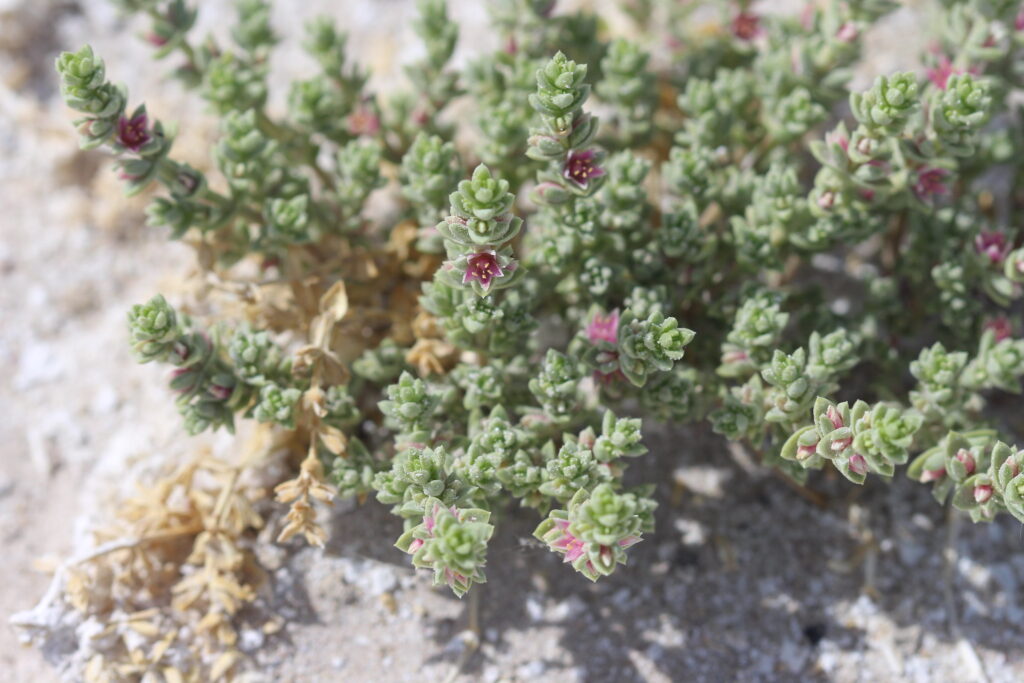
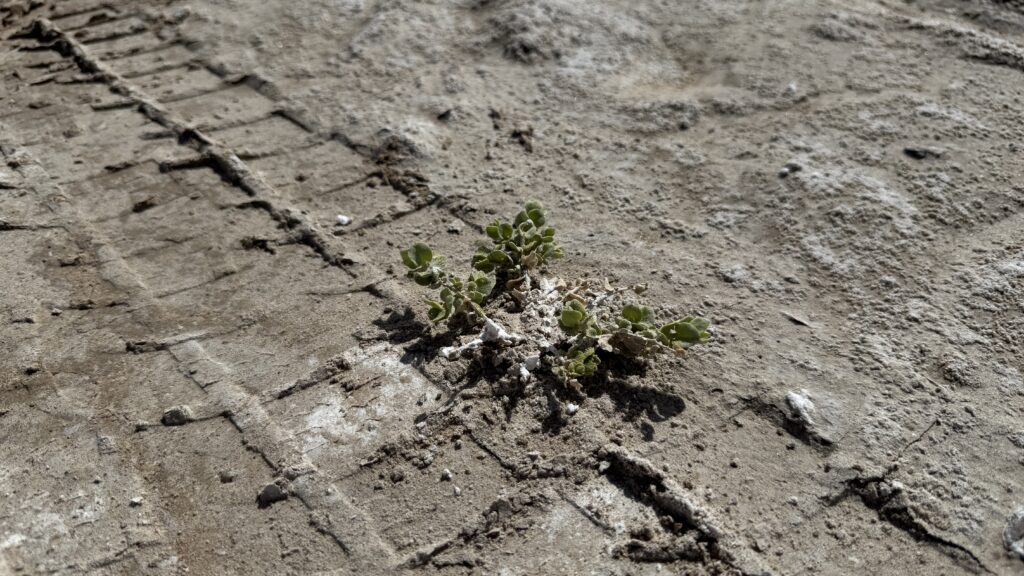
The Amargosa niterwort is federally and state listed as endangered, and Fraga emphasized its extreme geographic restriction: it occurs only in Ash Meadows, the Death Valley Junction area, and Tecopa Hot Springs—and nowhere else in the world. It survives in salt-crusted, alkali wetlands that depend on shallow groundwater.
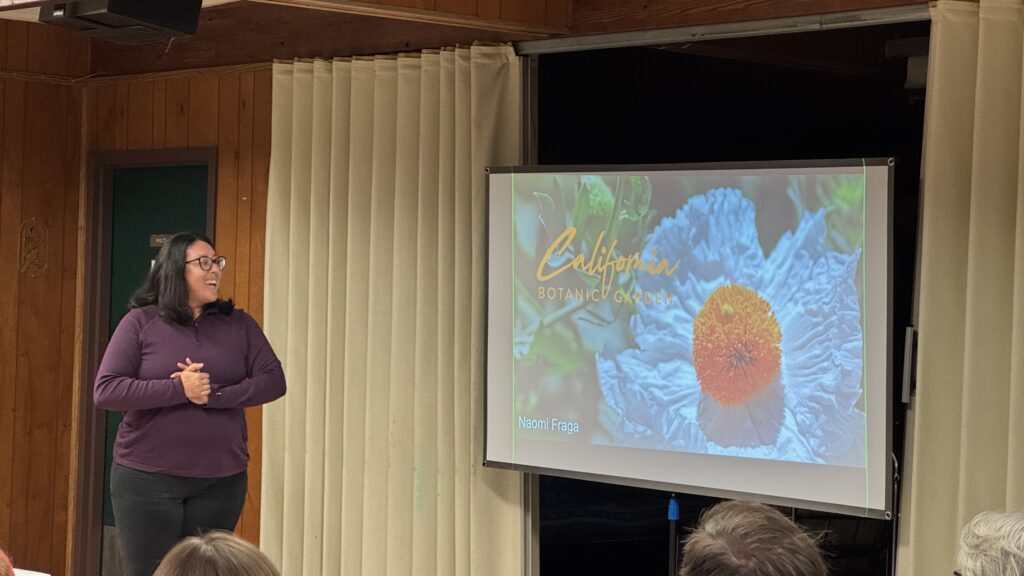
Fraga described the plant as “endearing,” with small flowers and a succulent-like form—but also as a microflora that’s easy to crush without realizing it. She shared that monitoring has detected a decline in the Tecopa area, with evidence pointing toward soil disturbance and vehicle impacts.
A key driver, she said, is that the landscape can look barren to casual visitors. Without context, people don’t understand they’re crossing habitat.
“Nobody would know if you went out there that it was a major plant habitat,” she said, noting the absence of on-site guidance. “There’s no education, there’s no information, no signage.”
What the project would do on the ground
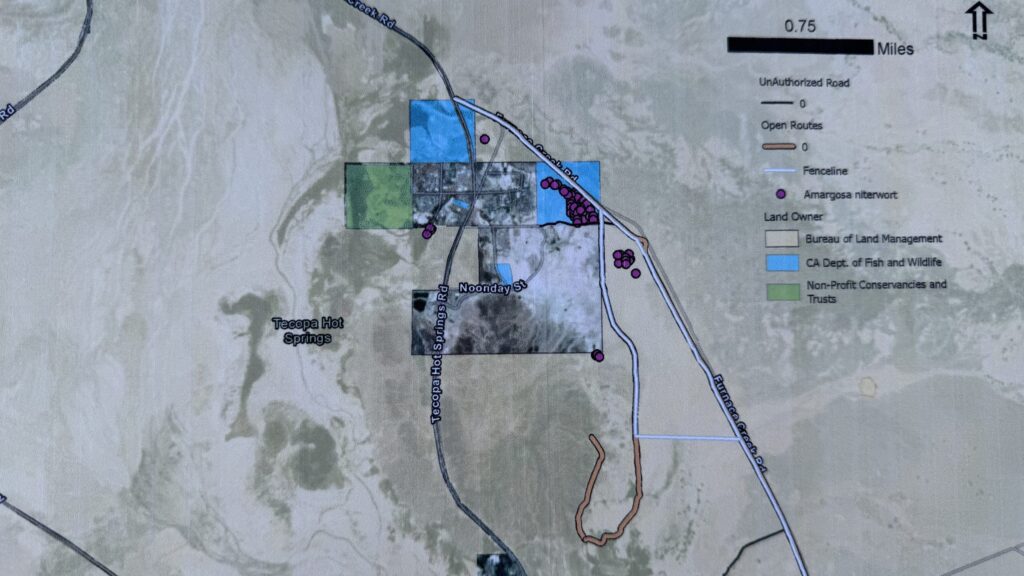
Using a map of land ownership and routes, Fraga walked the room through the specific interventions proposed near the miner’s tub aka the wild pool:
- Post-and-cable fencing along sections of Furnace Creek Road to prevent vehicle incursion into niterwort habitat.
- Additional fencing to close off an unauthorized route off what Google Maps shows as Elias Road that connects to Furnace Creek and currently enables vehicles to cut into sensitive areas.
- Preservation and maintenance of the existing foot trail leading from the back entrance near Death Valley Hot Springs toward the miner’s tub—keeping pedestrian access intact while discouraging vehicles.
- Interpretive signage placed where it naturally meets foot traffic, potentially near the end of the trail and/or where the path reaches the road.
Fraga emphasized that the proposed fencing is not intended to cut off access to the miner’s tub or Tecopa Hot Springs. The goal, she said, is to keep vehicles on established routes and prevent the gradual expansion of new tracks into sensitive alkali wetland habitat—especially along the unauthorized road.
Recent observations underscore why the Conservancy and its partners are prioritizing physical barriers. In the days leading up to publication, the unauthorized route via Elias was still seeing regular use, including a Jeep, dirt bikes, bicycles, and horseback traffic. Community-made warning signs were present but had been pulled up or turned around, suggesting informal measures are not holding.
Project staff say the challenge is partly structural: land management boundaries limit which agencies can mark or fence which segments of the route. The restoration team is working with multiple stakeholders—including Noel, the private property owner, the Bureau of Land Management and California Department of Fish and Wildlife—to align fencing, signage, and enforcement with property lines while still protecting the most vulnerable niterwort habitat. CDFW is already a project partner and is expected to assist with labor and materials.
Organizers say the approach will likely require sturdier infrastructure—such as a post-and-cable fence—because lighter deterrents can be bypassed or removed. The intent is to maintain public access on foot and along authorized roads while stopping vehicle incursions that are linked to documented declines in the endangered Amargosa niterwort population near the tub.
The fencing style discussed mirrors the “post-and-cable” look used nearby at Borehole Springs after last year’s fire: durable, visually legible, and “means business,” as one participant put it—without becoming a wall.
Outplanting—because no one has restored niterwort before
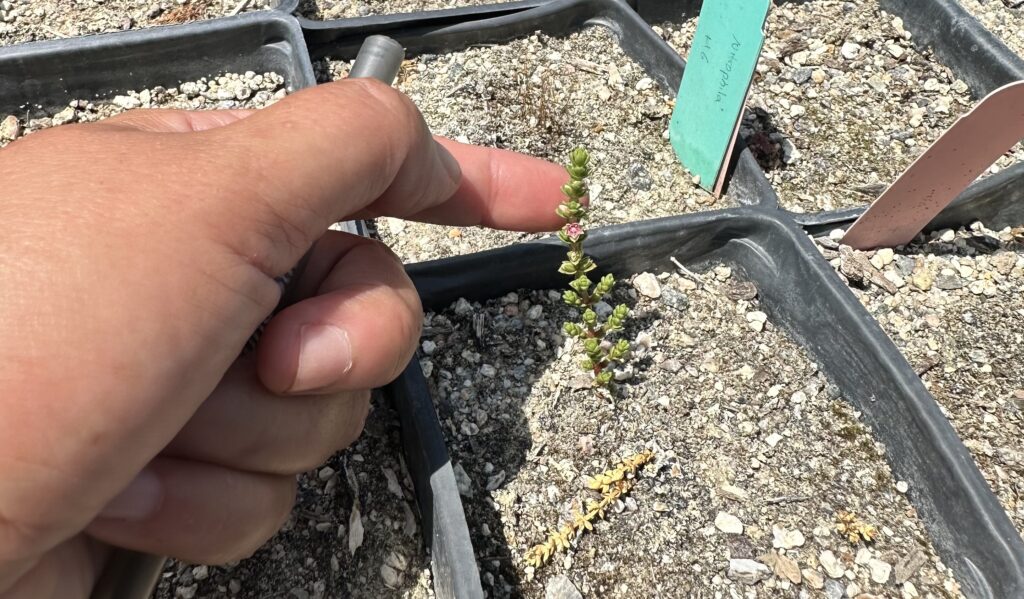
Beyond keeping damage from getting worse, the project aims to actively rebuild the population. Fraga described an outplanting effort using nursery-grown niterwort—undertaken as an experiment because no prior restoration framework exists for this species.
California Botanic Garden has already developed propagation methods, and Fraga explained a key constraint: niterwort doesn’t produce much seed, making conventional seed banking difficult. Instead, the garden propagates it by collecting small sections of underground rhizome and dividing them.
For genetic diversity, the donor material would come from multiple areas—primarily from the larger Death Valley Junction population—because Tecopa’s remaining plants are too few to harvest without risking further harm.
The experimental design includes testing:
- Timing (late winter vs. early spring planting),
- Density (clustering vs. spreading plants out),
- “Active” plots where plants are installed vs. “passive” plots where fencing is installed and the team watches to see if niterwort returns on its own.
Monitoring is intensive: Fraga described a summer census using grid squares to count “every single niterwort,” a process that takes about a week each July.
A community conversation about recreation, respect, and reality
As the discussion opened up, the meeting shifted from botany to lived experience.
Amy Noel, an owner of Tecopa Hot Springs Resort who said she has lived back in the area for more than twenty years, described a dramatic increase in traffic across the flats—especially during and after the COVID-era travel surge. She told stories of visitors driving minivans off-road, getting stuck in wet ground, and justifying their routes by saying they were “following the tracks.” She also pointed to a larger gap: a lack of clearly understood, locally supported places for off-road recreation that don’t sacrifice sensitive habitat.
Her comments captured a tension heard repeatedly in Tecopa: many visitors say they support conservation, but they arrive without context—assuming, for example, that because land is managed by BLM, off-road driving is acceptable.
“It’s a way of teaching,” she said, supporting fencing and urging signage that communicates what’s special about the place—without overwhelming the landscape.
Mandi Campbell, speaking as a member of the Timbisha Shoshone Tribe and someone who grew up in the area, added a sharper edge: she described a level of disrespect around the miner’s tub and surrounding waters that she said she “never, ever” saw in earlier decades.
She cited trash, cigarette butts, makeshift fire pits, people altering the pond’s flow, and what she described as the water’s diminished condition—mold and stagnation where it once “flowed freely.” Her message was not anti-access; it was pro-respect. People come to Tecopa for healing, she said, but the way the site is being used now undermines that purpose.
Campbell urged the group to consider rules that are limited but meaningful—potentially including a clearer stance on camping near the tub—paired with signage shaped by cultural stewardship: how to protect water, vegetation, and habitat as part of a single system.
Signage: highlight the plant—or keep it quiet?
One of the most practical debates of the night was also the most strategic: should signage explicitly call attention to the niterwort?
Cynthia Kienitz, owner of Cynthia’s Safaris and Basecamp, asked whether visitors could be encouraged to park, walk to the fencing, and view the plant from one side—turning conservation into a visible encounter. Fraga acknowledged the dilemma: highlighting the niterwort could build appreciation and compliance, but it could also invite trampling if people go looking for it off-trail.
Her response was cautious but open: the team wants people to see the plant because it’s special, and it does occur along the path—but any messaging would need to emphasize sensitivity and recovery.
Fraga stressed the same point in different ways: the habitat needs time to heal, and any new attention must be paired with clear guidance about where feet and tires should—and should not—go.
What happens next
By the end of the meeting, the outlines of the project were clear: fencing first, then outplanting; education paired with enforcement-by-design; and a continuing effort to shape visitor behavior without eliminating access.
The larger promise is that Tecopa could become the proving ground for a restoration method that doesn’t currently exist—one that could eventually be applied across the niterwort’s tiny range.
The smaller, immediate promise is more local: fewer fresh tracks across the flats, fewer vehicles pushing into shallow groundwater areas, and a hot springs landscape that feels less like an unmanaged overflow lot—and more like the rare wetland it actually is.
For a plant that survives on thin margins—salt, water, and a narrow band of undisturbed ground—that shift may be the difference between decline and recovery.
For now, the Amargosa niterwort is mostly out of sight—dormant in the salt flats and easy to forget. But it won’t stay that way. As the season turns and the summer sun emerges and bears down on Tecopa, the plant will rise and bloom again, insisting—quietly, stubbornly—that this fragile place is alive.
Leave a Reply