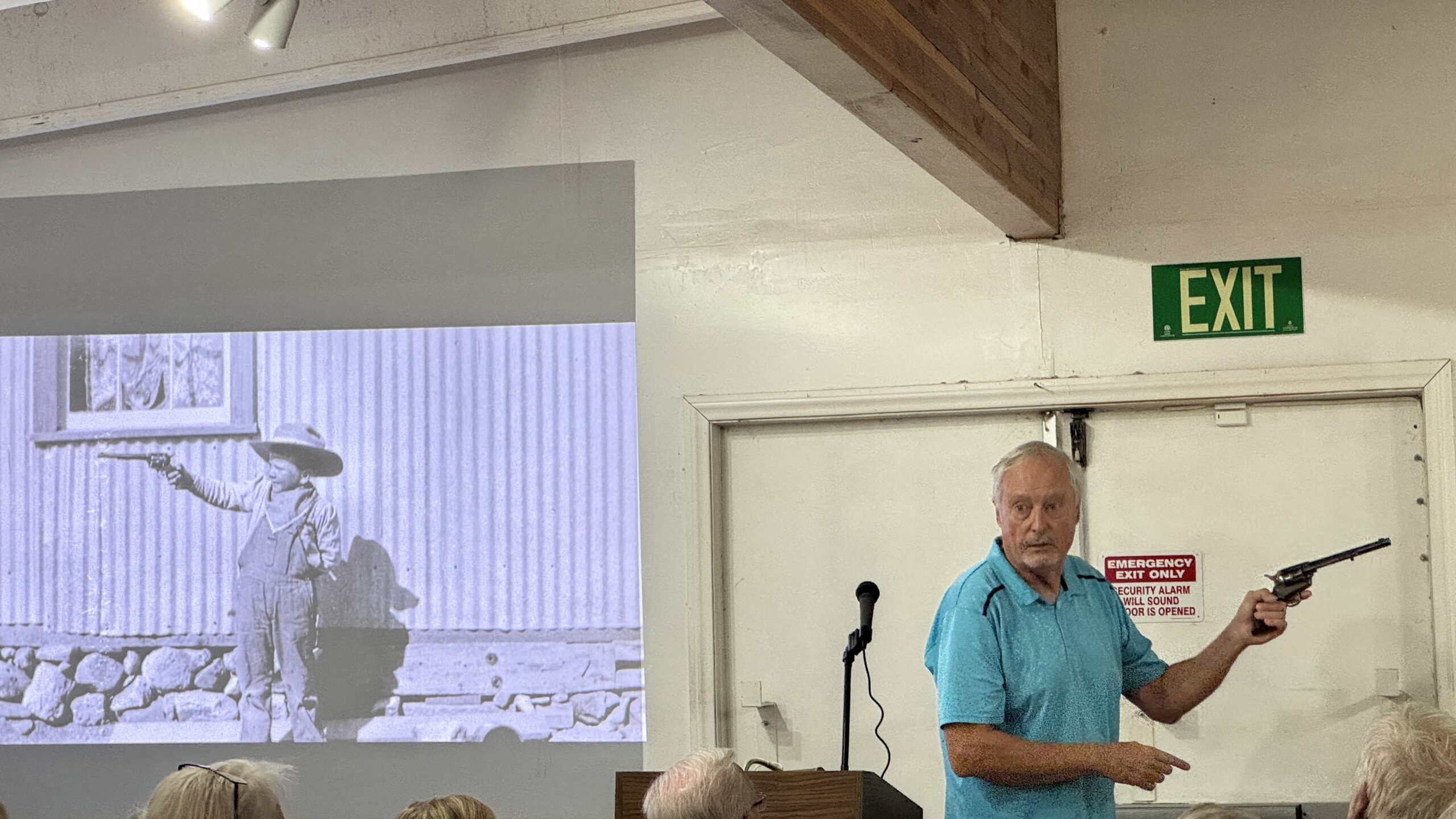
SHOSHONE, Calif., March 14 — When Brian Brown held up a small Colt revolver, the whole room gasped.
The .32-20 Winchester, shown in a photograph of his great-uncle Howard Corkill at a local mining camp and long remembered in family lore as a woman’s handbag pistol, embodied the kind of desert history Brown had come to tell: intimate, half-documented, and inseparable from the hard lives of the people who moved through the northern Mojave. From that single object, his talk widened into a larger story of freighters, borax workers, ranchers, merchants, and his family who built livelihoods in a landscape that demanded constant reinvention.
“This isn’t meant to be a formal history,” he told the crowd. “It’s just a bunch of fun pictures.”
His friend, the filmmaker Ted Faye, started clicking through the slides.
He wandered, doubled back and lingered on a face, a wagon, a ruin, a spring, a building half gone. Images moved from Death Valley Junction to Tecopa, from Ash Meadows to Baker, from borax camps to roadside businesses. It was family history, civic history, labor history, transportation history, desert history. It was also, unmistakably, a story about commerce: how people made a living here, how they lost one, how they found another, and how every generation in the northern Mojave seems to have had to reinvent the terms of survival.
He displayed the small pistol while discussing the isolation of mining camps and ranching settlements. The gesture startled the room just enough to make the point land: this was not abstract frontier imagery. In many of the places he was describing, tools of protection and hunting were ordinary facts of life.
Brown, steward of China Ranch Date Farm, stood in a building that was itself part of that story. Around him sat residents, descendants, neighbors, and visitors in a museum assembled from the very materials of regional continuity: relocated walls, saved photographs, remembered names, artifacts whose meanings might be secure or might need questioning. On the screen behind him appeared images of the place before it was a museum, before it was even in Shoshone, when it served a different set of desert needs. Its history, like nearly everything Brown discussed that afternoon, was not linear. It was adaptive.
That was the real subject of the talk. Not nostalgia. Not even preservation, exactly. Adaptation.
In Brown’s telling, the northern Mojave was never static long enough to become what outsiders imagine when they think of the word “historic.” It was too contingent for that, too shaped by heat, water, ore, roads, freight, rail alignments, labor demands, and the economics of distance. Places emerged because something needed to pass through them. They survived because someone found a way to make them useful again.
The economy before tourism
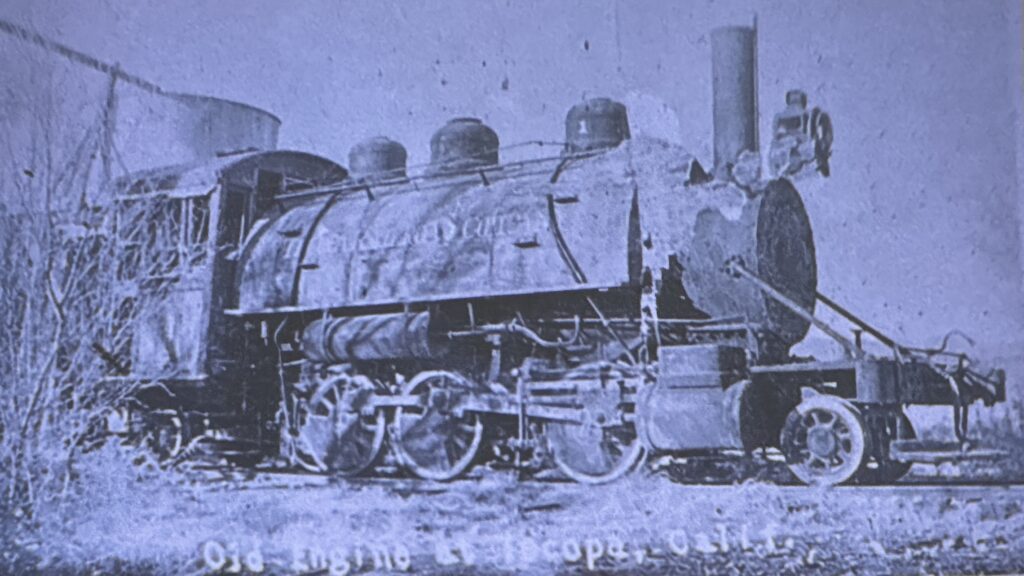
Long before the region became legible to outsiders as scenery, retreat, or destination, it was a working landscape. Brown returned again and again to that point, especially when he spoke about Tecopa.
Before tourism became a strategy, before chambers of commerce and heritage branding and destination marketing, Tecopa functioned as part of a larger industrial geography. It was not yet a place organized around visitation. It was a freight corridor, a seasonal support zone, a landscape of springs, hay, stock, camps, and movement. Ore, supplies, and mail moved through it. Animals had to be fed. Water had to be found. Workers had to survive the seasons.
Brown described a regional system in which transportation itself generated the economy. Draft animals were not incidental; they were infrastructure. Hay mattered because freight mattered. Springs mattered because hay and livestock mattered. Small agricultural operations existed not as pastoral exceptions to industry but as its support mechanism. In one of his most useful formulations, Brown made clear that places like Tecopa were not peripheral to the desert economy. They were part of the machinery that allowed it to function.
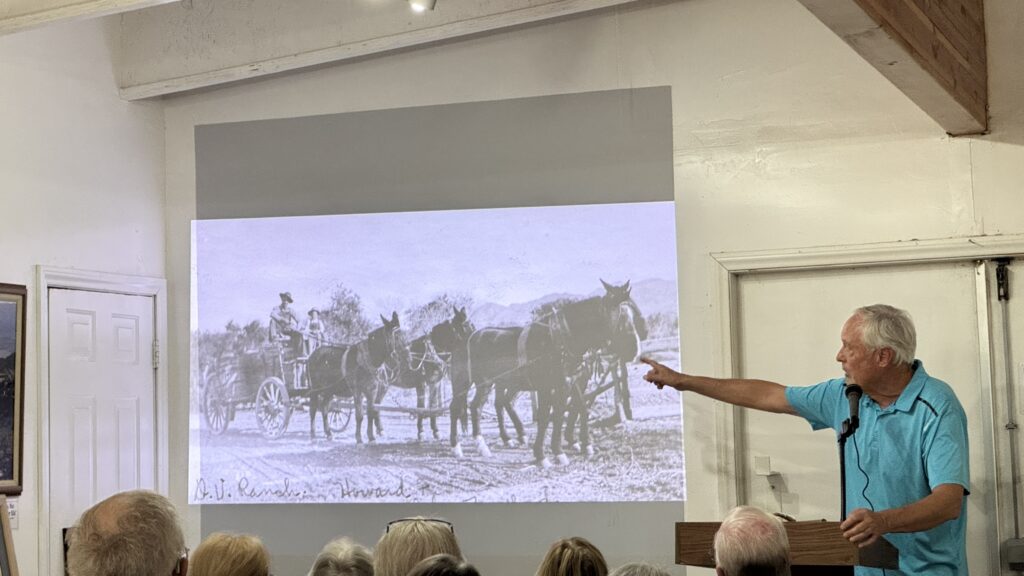
For a period, he said, old and new systems overlapped. Burros, wagons, rail lines, and early automobiles all shared the same landscape. The northern Mojave modernized late, or at least unevenly, and Brown treated that lag not as backwardness but as a defining regional condition. Here, technologies accumulated before one fully displaced the other. A teamster’s world and a motorist’s world coexisted. Desert life, in that sense, did not advance in neat stages. It layered.
The deeper history of that commercial landscape, in Brown’s account, ran through borax.
Borax and the Chinese labor that built the corridor
The desert economy Brown described did not begin with tourists or even with towns. It began, in practical terms, with extraction and the transport problems extraction created.
He spoke about Chinese labor crews working borax deposits first on the surface of valley floors and later in more developed underground operations. Their labor, central to the industrial life of the region, moved with the climate. In winter they worked in Death Valley; in summer many shifted toward higher ground near Tecopa. Brown’s slideshow made that seasonal migration feel less like a footnote than a governing logic. The economy moved with temperature. Settlement followed labor. Labor followed survivable conditions.
That pattern helps explain why Tecopa mattered.
Brown spoke of the Amargosa Borax Works between Shoshone and the Tecopa turnoff as a place of major historical significance, not a marginal ruin. In his telling, it was one of the earliest bases of the famous twenty-mule-team system, a site where the iconic image of desert borax freight had actual operational roots. He noted that in his childhood there had been far more to see there. Structures that once stood more fully have eroded, collapsed, or been vandalized away. What remains now can seem minor if you do not know what you are looking at. Brown did know, and part of the force of the presentation came from the gap between the scale he described and the fragments that survive.
History, he implied, is often not lost in spectacular fashion. It is thinned out, tagged, burned, weathered, and forgotten one wall at a time.
From within that industrial system came one of the talk’s most resonant figures: Ah Foo.
Ah Foo and the founding of China Ranch
If borax was one foundation of the regional economy, then China Ranch, in Brown’s telling, began as one of its earliest acts of diversification.
According to Brown’s account, drawn from payroll records and local memory, a Chinese worker known as Ah Foo received a small payment from the borax company and left industrial labor behind. He moved into the canyon near Tecopa, found a dependable spring, and began the harder, quieter work of trying to make a living from the land. He raised livestock, planted vegetables, and cut hay. The place became known as the “Chinaman’s Ranch,” a name later shortened to China Ranch.
The origin story matters for more than nomenclature. It places China Ranch inside the labor history of the Amargosa Basin rather than outside it. The ranch was not some separate pastoral idyll on the margins of mining. It emerged from the same economic world and from one worker’s attempt to step out of wage labor and into a more self-directed, if still precarious, form of desert subsistence.
Brown treated that move as both practical and emblematic. If borax represented one kind of desert commerce, China Ranch represented another: a small agricultural foothold built in the cracks of an extractive economy, dependent on water, labor, and local conditions, vulnerable to heat and distance, but potentially more enduring than a mine.
Not that it was easy.
Later owners, Brown made clear, struggled repeatedly to make conventional ranching succeed there. People tried livestock. They tried hay. They tried making a life out of a landscape that rarely rewarded effort in proportion to work. The canyon’s spring gave them a chance; the broader economics did the rest.
By the time Brown’s family bought the place in 1969, they inherited not a romantic oasis but the accumulated problem of how, exactly, one makes China Ranch pay.
Hay, dates, and the economics of reinvention
Brown’s own story at China Ranch is, in many ways, the clearest example of the larger pattern he traced across the northern Mojave.
When his family acquired the property, the old model still held enough force to be attempted again. He continued trying to grow hay and operate something resembling a traditional Western ranch. But the economic world that had once made hay indispensable had changed. Draft-animal transport had long since ceased to be the engine of desert commerce. Hay was no longer the fuel of regional mobility. The old rationale had eroded.
Brown did not present this as abstract economic history. He presented it as lived arithmetic. Hay was hard. Dates, once he and his late wife Bonnie began to lean into them, offered another possibility.
He described a transition that was not sudden or glamorous. It involved hand-harvesting small crops, loading them into pickup trucks, and selling them at swap meets and roadside stops. It involved noticing that one product brought in more than another, that one kind of labor opened a future and another did not. It involved Bonnie’s practical role in seeing what the numbers suggested before the operation fully changed shape.
That shift—from hay fields to date palms—is one of the cleanest narrative arcs in the talk, and Brown seemed to recognize it as such. It is a commercial reinvention story, but also a regional one. The same desert that once supported freight by feeding animals would, under altered economic conditions, support a specialty crop tied to tourism, retail, and destination identity. The land had not changed much. The market had.
In Brown’s account, that is the story of the northern Mojave in miniature.
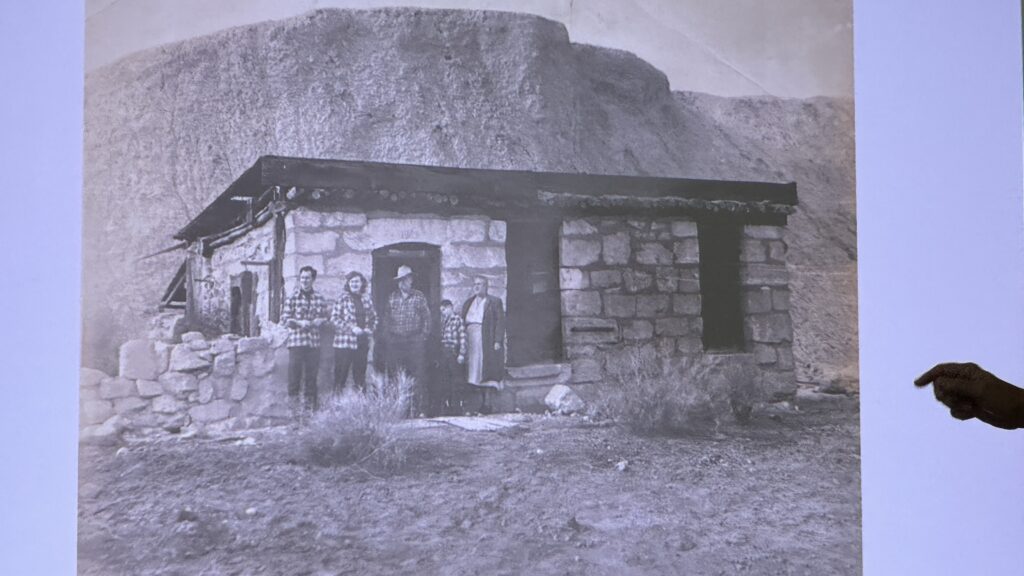
Brown lingered briefly on the old assay building below China Ranch, a modest structure that once stood as a relic of the region’s early nitrate speculation, when prospectors brought samples there to be tested for salts used in the manufacture of explosives. For most of his life, he said, the building remained in place — weathered, fragile, but still legible as part of the industrial afterlife of the canyon. Its recent collapse, which he attributed with frustration to the failure of federal stewardship, stood in his telling as more than the loss of one ruin. It was another instance of desert history slipping away not only through time and weather, but through neglect: a small but irreplaceable piece of the northern Mojave’s commercial past reduced to absence before it could be meaningfully preserved.
The Fairbanks line and the logic of movement
Where China Ranch supplied one family’s example of adaptation, the Fairbanks side of Brown’s family supplied another, on a wider territorial scale.
Brown traced the Fairbanks line through freighting, ranching, railroad commerce, and highway business. R.J. Fairbanks moved goods between the far more urban mining districts of Rhyolite, Beatty, and Goldfield. On one of those journeys he identified a major spring in Ash Meadows and established a foothold there. That one detail carried much of Brown’s historical method in it: follow the water, and the settlement story clarifies.
But water alone was never enough. Transportation patterns changed, and the Fairbanks family moved with them.
After time in Greenwater, the speculative copper camp that flared and failed, Fairbanks shifted to Shoshone, where the Tonopah & Tidewater Railroad made the town a transfer point for freight, mail, and travelers heading into Death Valley. There Brown’s family history intersects with the wider making of the town itself. Shoshone was not just a settlement; it was an interface, a point where rail, road, supply, and community crossed.
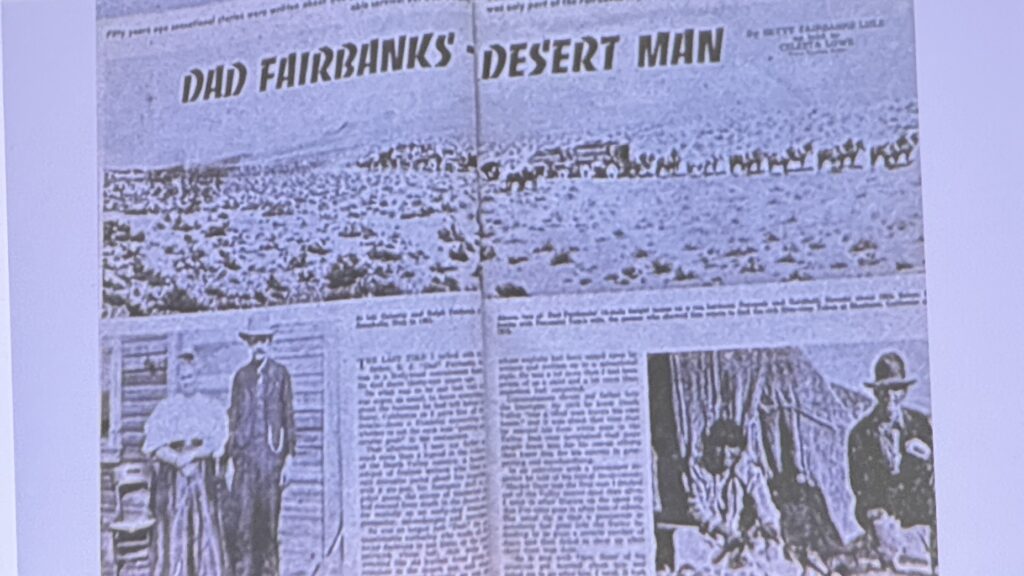
Brown paused over an old magazine profile of Ralph “Dad” Fairbanks to make a point about the uneasy border between history and legend. The article, he suggested, did what so much popular writing about the desert has always done: it took a real man, a real habit of helping stranded travelers, and a real life shaped by hardship and service, then burnished those facts into something larger, rougher, and more heroic than ordinary truth usually allows. Fairbanks did go out into the desert for people who were lost or broken down; that part, Brown made clear, was real. But in print, practical acts of rescue became the raw material of mythology, transformed into the kind of frontier archetype magazines liked to sell — a “desert man” larger than life, standing in for the whole romance of the Mojave. The result was not exactly false, but neither was it simple truth: it was history lifted into legend, where fact remains visible beneath the varnish.
Then, as the age of automobile travel asserted itself in a new direction, the family moved again, south toward the Arrowhead Highway near present-day Baker. There markets, fuel stops, and roadside businesses prospered amid the truck traffic associated with Hoover Dam construction. Commerce flowed where infrastructure flowed. The family followed.
Brown’s treatment of the Fairbanks story never felt like genealogy for its own sake. It was a method of showing how families survived by reading the region correctly. They did not simply endure in place. They repositioned. They recognized when one transportation regime was ending and another was beginning.
That same pattern appears in Brown’s account of his grandfather Charles Brown, though there it takes on a civic and political dimension.
Charles Brown and the making of a town
If the freighters and ranchers in Brown’s talk embodied the improvisational economy of the desert, Charles Brown represented something else: the maturation of settlement into public life.
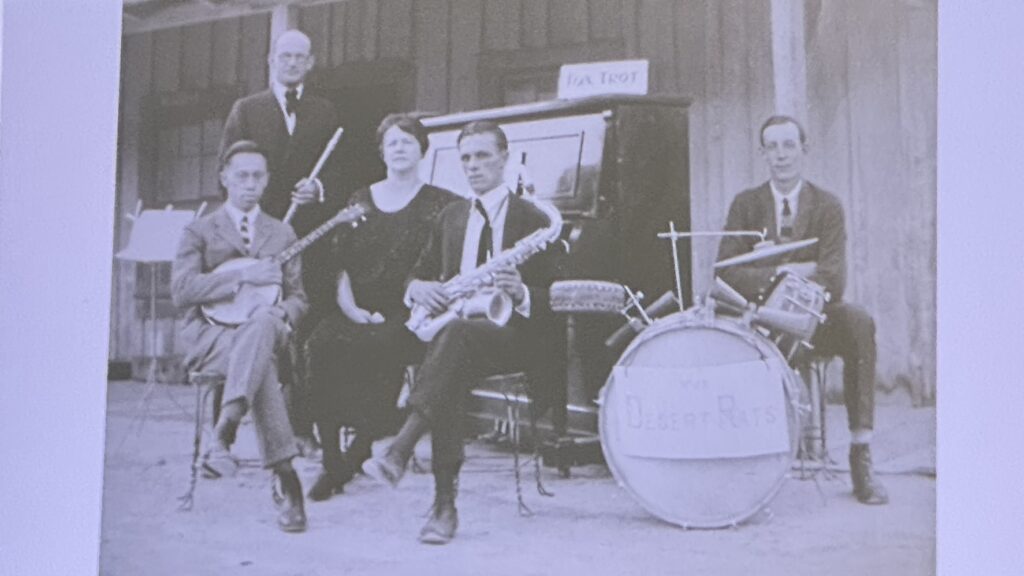
Brown described his grandfather beginning as a mechanic and businessman in Shoshone, a man rooted in the practical needs of a service town. From there he rose into elected office, becoming an Inyo County supervisor in 1928 and later, in 1938, a California state senator. He served for more than two decades.
That progression—mechanic to senator—contains a whole civic history within it. Brown seemed especially interested in the fact that political stature did not erase local embeddedness. Charles Brown kept returning home. He remained, in family memory and in the photographs shown, tied to the daily life of Shoshone. The talk’s images of community events, school gatherings, and local celebrations reinforced Brown’s broader point that Shoshone was never merely an outpost. It was a functioning social world.
There was also, running beneath this part of the talk, a subtler commercial history: the way civic leadership and economic strategy intertwined. Shoshone’s survival depended not only on labor and location but on decisions about roads, services, tourism, and identity. Charles Brown belonged to that transition point, when a town built around movement and supply began to imagine itself as a community with a future to manage.
That bridge between extraction and tourism surfaced again in another of Brown’s stories: the road to Dante’s View, which he credited to the period when Death Valley was beginning to be promoted as a destination, not just worked as a field of industry. Brown’s larger point was clear even when implied rather than stated. Tourism did not replace mining in a single stroke. It emerged gradually, through roads, viewpoints, publicity, and local people willing to help shift the terms of regional value.
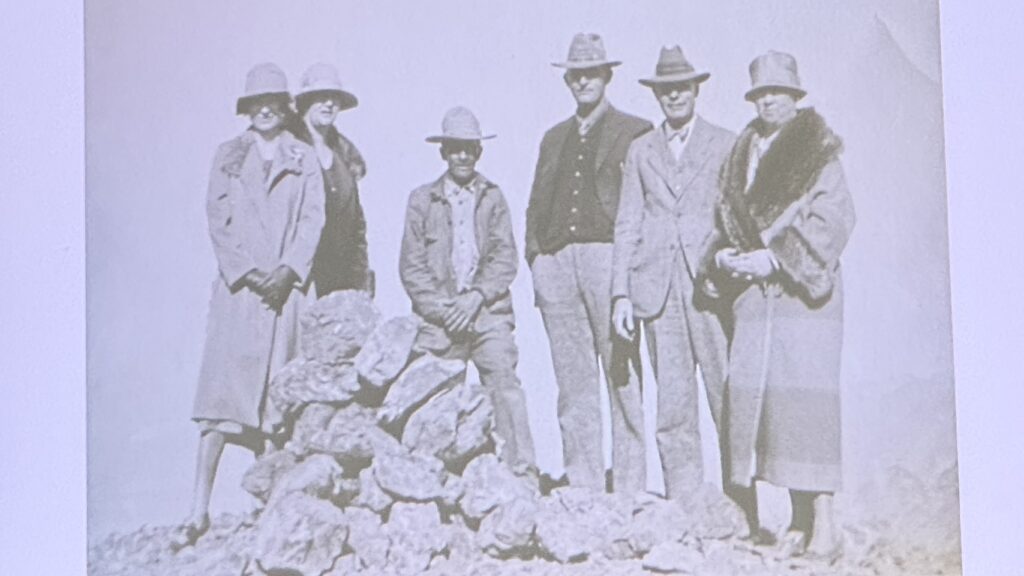
Brown described Dante’s View as an early tourism project that grew out of local efforts to make Death Valley accessible not just to miners and railroad men, but to sightseers. In his telling, the road to the overlook was closely tied to his grandfather, Charles Brown, who as an Inyo County supervisor helped secure funding and hire the men needed to build it. Brown said local officials and boosters had recognized the spectacular view as an asset worth developing as they began trying to promote Death Valley as a destination. He showed a photograph of the dedication ceremony at the overlook and identified several family members and local figures in it, including Charlie Brown and road builder Frankie Casey. The moment, as Brown presented it, marked a shift in the regional economy: the same desert once organized around freight, borax, and mining camps was beginning to be repackaged for visitors, with roads and viewpoints turning scenery itself into infrastructure.
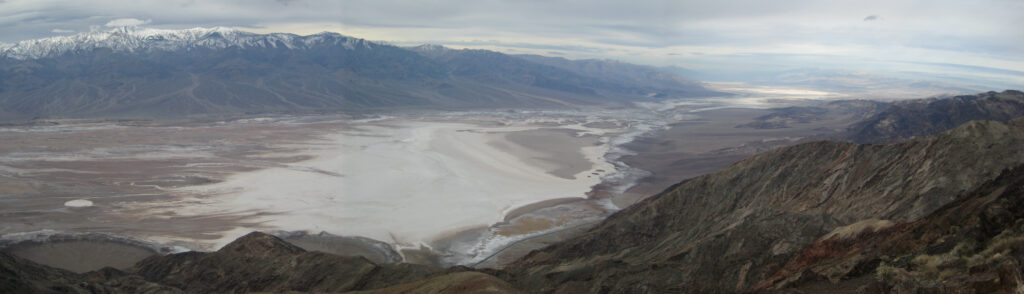
By the late twentieth century, that shift had become a matter of survival. Today, Dante’s View is known in pop culture history, serving as a filming location for the 1977 Star Wars, where its sweeping desert overlook stood in for the vantage point above the fictional Mos Eisley spaceport on Tatooine.
When the towns nearly died
Brown spoke with particular force about the period when the old desert economy had declined enough to make the future of towns like Shoshone and Tecopa feel uncertain.
Mining had contracted. Populations had fallen. Schools were threatened. The logic that had once sustained local commerce no longer held. In Brown’s telling, this was not a sentimental crisis but an economic one. The towns could simply stop existing.
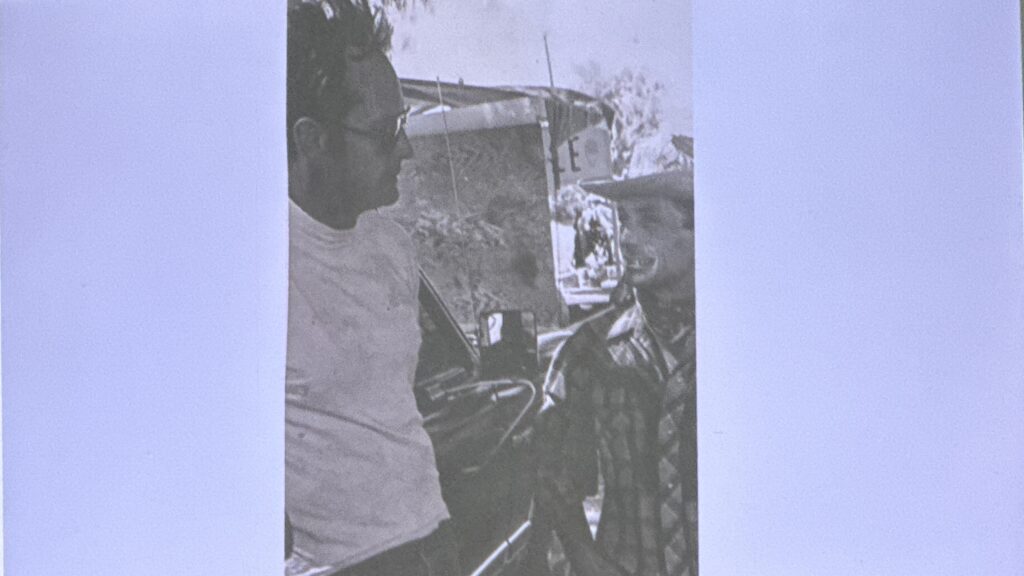
It was during this portion of the talk that he showed a photograph of himself with Paul Watkins, the first president of the Death Valley Chamber of Commerce. Watkins, who had earlier achieved national notoriety for his association with Charles Manson before later cooperating with prosecutors, settled in the region and became a key figure in local civic efforts. Together, they were trying to figure out how to keep the region alive. Brown described attending seminars and planning meetings with him and others as they searched for strategies that might stabilize desert communities after mining.
Tourism, heritage, local distinctiveness—these were not marketing abstractions in Brown’s telling. They were survival tools. The region needed something new to sell. Or perhaps, more accurately, it needed to learn how to sell what it had become.
That insight gave retrospective coherence to much of the presentation. The freighters, the ranchers, the railroad people, the roadside business owners, the date growers, the chamber organizers: all were engaged in the same underlying work. They were trying to convert place into livelihood without exhausting the place beyond repair.
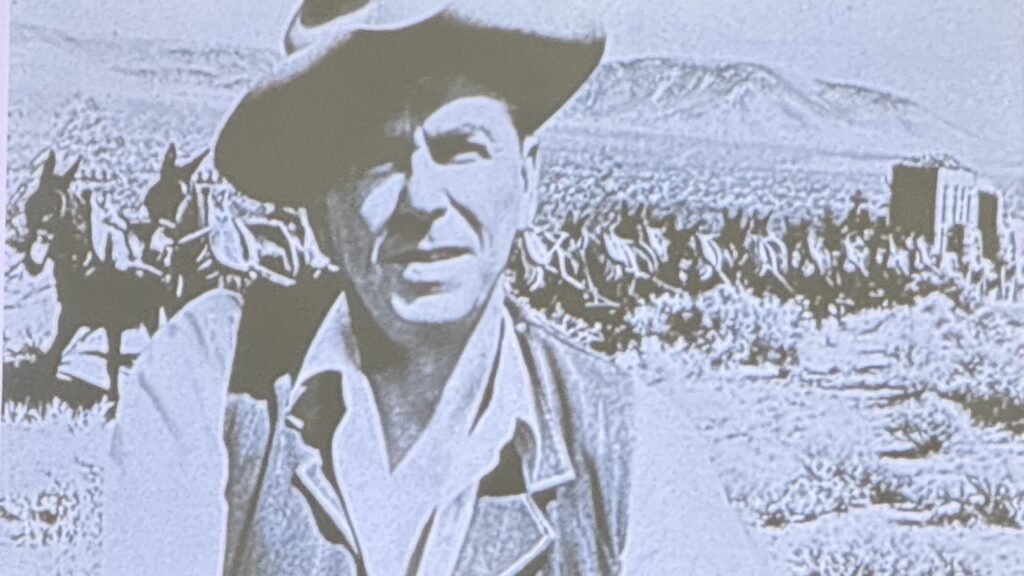
Among the more unexpected images Brown shared was a photograph of a young and rugged Ronald Reagan with a 20 mule team, doing some publicity himself. He is shown not as a future president but as one more figure passing through the wider world of desert history. Brown introduced the image with a wry aside that Reagan later “changed occupations,” using the moment to underscore how the northern Mojave has long intersected with lives that would later take on much larger public significance. In the context of the talk, the photo served less as a political reference than as another reminder that the region’s history is full of crossroads — a place where miners, freighters, laborers, performers, and future public figures all briefly entered the frame before heading elsewhere.
The building everyone was sitting in
One of the most effective turns in the presentation came when Brown showed old photographs of the very building the audience occupied.
Before it became the museum, he explained, the structure had stood elsewhere, closer to the Tonopah & Tidewater Railroad alignment. It had functioned as a general store and service point, a place where travelers could get what desert travel required: food, supplies, tires, practical help. In other words, the building itself once participated directly in the commercial system Brown had been describing all afternoon.
Later it was moved, repurposed, stabilized, and incorporated into a different economy—one built partly on memory.
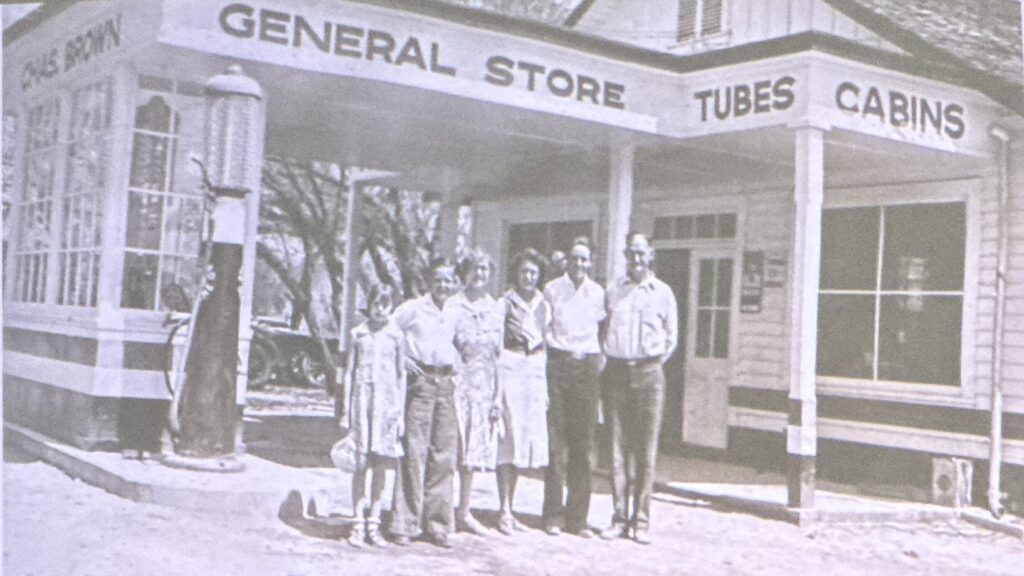
That sequence gave the room a charge. The museum was not merely a container for history. It was an artifact of adaptation, a building whose own biography mirrored the region’s. It had sold practical necessities to travelers entering Death Valley. Now it held the stories of the systems that made such travel possible.
Brown’s use of the building as evidence also sharpened one of the talk’s central claims: desert communities often survive not by preserving things untouched, but by moving them, reusing them, and giving them new work to do.
What remains
By the end of the afternoon, Brown had assembled more than a slideshow. He had built a regional theory of survival.
In his account, the northern Mojave is a place where economies have repeatedly had to migrate from one form to another: from borax to freight, from freight to roadside service, from ranching to dates, from extraction to tourism, from utility to heritage. Water determined one layer of that story. Transportation determined another. Family persistence ran through all of it.
The phrase Brown used early on—“a bunch of fun pictures”—was funny because it was so understated. The pictures were fun. They were also evidence. They documented vanished commercial systems, social worlds, labor structures, and acts of reinvention. They captured the moments before a building moved, before a mine collapsed, before a freight route disappeared, before a hay field gave way to date palms.
The desert, Brown showed, does not preserve history automatically. It erases with elegance. Adobe melts back into ground tone. Wooden structures burn. Rail alignments flatten into rumor. An industrial corridor becomes quiet enough that a newcomer might never guess what once passed there.
Brown’s talk made clear that desert history is not a chain of vanished places so much as a record of repeated adaptation. The old photographs do not simply show what has been lost. They show how people here kept finding ways to stay.
In the northern Mojave, that may be the most enduring tradition of all.

Leave a Reply