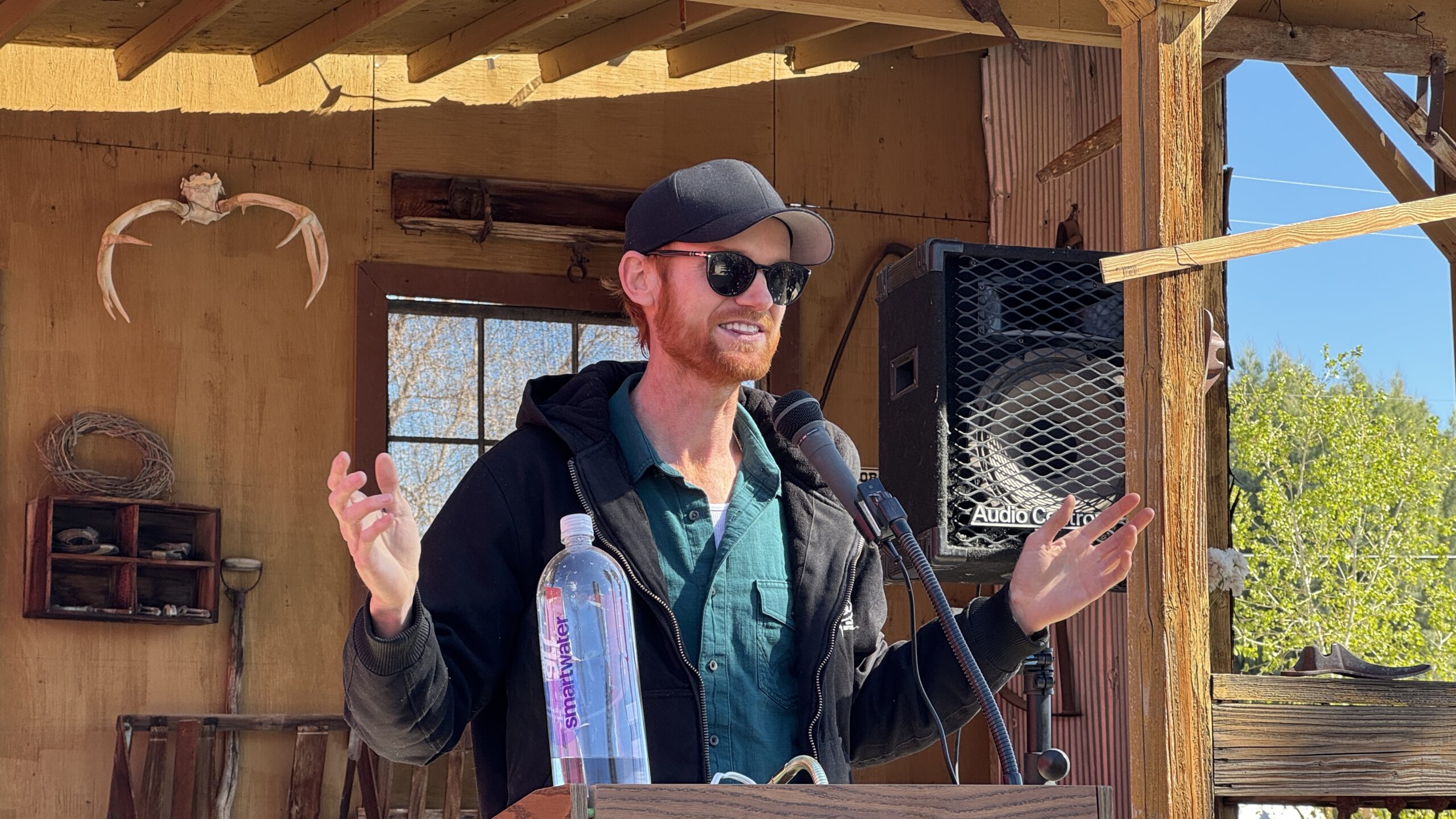
If you’re wondering—are there any ghosts in the ghost town Cerro Gordo?—Brent Underwood was on hand in Shoshone recently to answer those questions.
“We have a guy named Craig, he’s a very salt of the earth guy. He’s an electrician and works with DWP and he has a ‘girlfriend’ that he sees every night when he stays up there and goes outside the church. I don’t know if it’s coincidental that it happens after about eight Coors Banquets.”
The line brought easy laughter from a packed Shoshone Museum crowd seated in the sunshine between the Crowbar and the Flower Building—then Underwood pivoted to the real hauntings: an eight-mile road that washes out like it’s got a grudge, a 1,000-foot well that may or may not hit water, and the slow, permit-heavy work of keeping a high-desert mining town alive without turning it into a theme park. Underwood walked the crowd through the long, complicated life of Cerro Gordo, the 8,200-foot mining town above Owens Lake that he bought in July 2018 and has lived in full-time since March 2020.
He began with the town’s origin story: early prospecting, small “borras”-style refineries, and the moment local merchant Victor Beaudry recognized the quality of the silver moving down to Fort Independence and followed it back up the mountain. Around the same time, mining engineer Mortimer Belshaw arrived with capital, connections, and the appetite to industrialize what had been a rough camp. The population, Underwood said, surged almost overnight—turning a few dozen miners into a full-fledged Western boomtown perched between two worlds: the Sierra Nevada and Death Valley.
From there, he sketched the machinery of the boom. Cerro Gordo’s Union Mine was built around a deep vertical shaft—about 900 feet down, with an estimated 30 miles of workings spreading out from it—and the town ran on galena ore (lead-rich with silver as a byproduct). He quoted a U.S. Geological Survey production figure for the peak years: 3.2 million ounces of silver in a three-year span. But he also emphasized what that production felt like: a 24-hour town of smelters, businesses, and constant extraction—nothing like the quiet visitors associate with the site today. With wealth came volatility: no real police force, lawsuits and shootouts, a cemetery filling with miners, and the brothel economy anchored by figures like Lola Travis, who expanded her business reach into neighboring camps like Lone Pine and Darwin.
By the late 1880s, the first silver era faded as the richest ore bodies—“chimneys,” as miners called the vertical cracks filled with mineral—were heavily mined. The town slid into an early ghost-town phase, reduced to a handful of people “poking around,” until another engineer, Lee Gordon, arrived around 1910 and saw value where others hadn’t: smithsonite, zinc carbonate. That discovery launched Cerro Gordo’s second major boom. Underwood described the aerial tramway built during the zinc era, carrying material down toward Owens Lake—a reminder of how infrastructure, water, and transport have always determined whether desert places can survive.
Ownership shifted in the decades that followed, including a period when a caretaker was effectively handed the town as back wages—an arrangement Underwood recounted with a laugh, imagining the surreal hangover moment of waking up to “owning a whole town.” That caretaker, he said, responded by selling off pieces of the place—stories persist of a “$5 a bucket” era when artifacts walked down the mountain. Later owners included Barbara Smith and, famously, actress Jodie Stewart (and partner Mike Patterson), who ran Cerro Gordo for years with a vision of hospitality and historic revival—until their son Sean listed it for sale in 2018.
Underwood’s own entry into the story, he told the crowd, began far from Inyo County: Florida, then Texas, where he ran a bed-and-breakfast in an old Victorian mansion and came to love the overlap between history and hospitality. A friend sent him the listing—“buy your own ghost town for under $1 million”—half as a joke. Underwood took it seriously, leveraged everything he could, and bought Cerro Gordo with what he described as an aggressive “hard money” loan. The real turning point came with COVID. When hospitality work collapsed in spring 2020, he packed up, drove out, and arrived to a snowstorm in house slippers—an entrance he now calls comically unprepared. He planned to stay a month. Nearly six years later, he’s still there.
What changed, he said, was realizing that restoration isn’t only construction—it’s context. Reading the town’s papers and old reports made his work feel less isolating and more continuous: people before him had struggled with the same fundamentals—roads, water, winter, distance, money. That sense of being “painted into” the larger history, he said, is part of what he hopes others can find in their own communities by learning the stories beneath ordinary landscapes.
Looking forward, Underwood described a vision for Cerro Gordo that aims for a careful middle ground between Calico (amusement-park energy) and Bodie (preserved, “look and don’t touch”). Cerro Gordo, he said, should remain tactile—walkable, inhabitable—without turning into a performance. He framed that tightrope with the Ship of Theseus thought experiment: how much can you replace before the thing stops being itself? For him, every material choice—roofing, walls, finishes—has ethical weight because it shapes what the place will become.
Much of the Q&A focused on the practical realities behind that philosophy. The long-delayed hotel project—five years in progress—will eventually offer seven rooms, plus a bar and restaurant downstairs. Underwood highlighted one showpiece: an ornate 1800s Brunswick bar rescued from a Texas building, which he plans to install at Cerro Gordo.
Utilities, he noted, are a constant negotiation with geography and bureaucracy. Power exists largely because Los Angeles Department of Water and Power maintains infrastructure for a repeater tower above the town—meaning repairs can happen quickly when they need it, and Cerro Gordo benefits. Water remains the defining constraint. Underwood retold the town’s early water history: hauling by mule; then an ambitious 11.5-mile pipeline to a spring; a brief celebration when running water arrived; and the inevitable collapse when overuse reportedly drew the spring down. Later, miners collected water seeping into the 700-foot level and pumped it upward, but Underwood said attempts to rely on mine water have repeatedly failed. Now, he’s drilling a 1,000-foot well—an expensive gamble, but one the county effectively requires for commercial occupancy. He told the audience drilling was expected to begin within days, and asked for crossed fingers.
Road access—another historic problem—came up repeatedly. The main eight-mile dirt road climbs from Keeler with steep switchbacks, and Underwood pointed out the irony that Belshaw built it in a wash, guaranteeing storm damage. In theory, the county maintains it as a utility road; in practice, he often does repairs himself. Winter conditions had recently made the route impassable with deep snow. He also described alternate approaches through Death Valley (longer, rougher) and via the old Saline Valley Salt Tram route (the most difficult).
Several questions turned toward preservation of memory, not just buildings. Underwood said descendants of former residents and workers increasingly reach out—often because the YouTube channel makes the town visible again—and sometimes bring rare primary sources: journals, ledgers, and family accounts that fill gaps in the official record. He noted that courthouse fires and an earthquake wiped out many county documents, which is why assembling a robust archive now matters. He encouraged people to explore digitized historic newspapers—especially the University of California, Riverside’s collection—which he uses frequently in his videos.
He also touched on what restoration looks like after loss. Cerro Gordo’s original American Hotel, built in 1871, burned in an electrical fire about five years ago. Underwood said two stoves were saved; the smaller wood-burning stove will be restored and returned to the rebuilt hotel, while the massive cast-iron kitchen stove is too large and impractical to reincorporate.
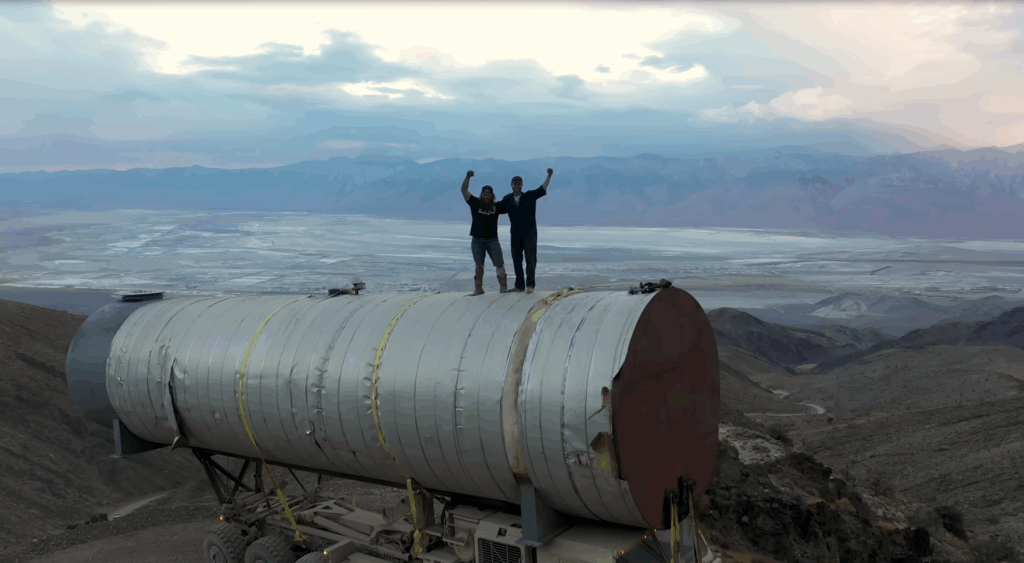
From there, the talk widened into the “how” of doing hard projects in remote places. Underwood credited unexpected collaborators—like Discovery Channel’s ‘Diesel Brothers’ turned YouTubers, Dave Sparks (“Heavy D”), Diesel Dave and their team from Utah—for solving logistical problems no ordinary contractor would touch, including hauling materials and pouring 80 yards of concrete in a single day using an off-road concrete truck and palletized “super sacks.”
Underwood also stressed that Cerro Gordo’s future can’t rest on mining history alone. One of the projects he’s most excited about, he said—developed with singer-songwriter Haley Dahl—is the restoration of an 1870s cabin into a recording studio, a way to welcome artists into the town’s orbit and let new work grow out of an old place. It fits his larger aim: to create many different on-ramps to Cerro Gordo so musicians, volunteers, hikers, historians, and builders can each leave a small “thumbprint” without sanding off what makes the town itself. When the conversation turned to alternative construction—earthbags, adobe, building with on-site materials—Underwood leaned in, but returned to the reality that governs every romantic idea up there: permits, codes, and the limits of what a remote mountain site can reliably support.
He closed the public portion not with a grand pitch, but with something closer to an invitation: Cerro Gordo is hard, it’s slow, and it demands intentional choices—but the reward, he said, is watching a real community form around a place most people once considered finished. As the questions continued, he began describing ideas for safer access—such as staging at the property in Keeler for visitors who don’t want to drive the road themselves.
As the questions turned from history to logistics, Underwood lingered on one of Cerro Gordo’s oldest barriers: getting there. He described a future where visitors who are curious but uneasy about the steep, exposed dirt road could still make the trip without “white-knuckling” the whole way. One idea, he said, is a shuttle system staged from the property at the base of the hill—limited runs a day that would let people relax, learn the story on the climb, and arrive ready to explore. Underwood admitted he’s become desensitized after years of daily drives, but said he’s seen visitors reach the top and refuse to drive back down at all—forcing his team to bring their vehicle down for them. “Eventually,” he told the crowd, “we’ll hopefully have a way for people to come up if they’re not comfortable with the road.”
Asked about his recent hikes to remote mining camps, Underwood said he uses travel the way some people use archives: to find inspiration in what others got right—and wrong. He has been roaming the Inyo Mountains, the rougher, less-traveled range east of the Sierra Nevada, where canyon after canyon holds old camps preserved largely because of their isolation. Unlike the Sierra, with its famous trails and constant foot traffic, the Inyos are rugged and quiet. Underwood said he’s spent roughly 60 days hiking there and has “never run into another person” in the range. He noted one of the surprises for newcomers: in a landscape many associate with dryness and emptiness, some canyons still hold streams, waterfalls, and pockets of beauty that feel almost out of place—“you’ll be in Death Valley… and you’ll come across streams.”
When someone asked the most direct question—how to help—Underwood answered in practical terms. Financially, he pointed to Friends of Cerro Gordo, a nonprofit arm supporting the work. For people who want to contribute time, he said volunteer weekends are frequent. He mentioned a merchandise store, the YouTube channel (where views provide meaningful support), and the simplest option: tell friends. He added, with a grin and a nod to the moment, “And buy the book today.”
Then he offered a kind of hyper-specific donation list that only makes sense if you’ve lived for years on a mountain with limited supplies: bottled water and paper towels. “Non-perishables we can always use,” he said—small items that become essential when you’re far from a grocery store. Asked if there’s an Amazon wish list, Underwood said yes: it’s linked on their rebuilt website, CerroGordoMines.com, alongside volunteer and nonprofit information. Deliveries still don’t reach Cerro Gordo directly, he added—no drones “or otherwise.” He makes his supply run into Lone Pine about once a week. “Maybe one day,” he said.
From there, Underwood circled back to what he’d framed earlier as his deeper reason for studying desert history: when you’re working alone in the middle of nowhere, it can be hard to find peers in the present—but the past is full of them. He described the story of Burro Schmidt, a man who moved to California hoping to outpace tuberculosis and then spent 38 years tunneling through a mountain by hand—an obsession that, to some, might look like futility. To Underwood, it reads as proof that persistence can leave a mark big enough to outlast the doubt. He called these figures “proxies”—people he can see himself in when he needs clarity.
He described another desert life that has been pulling at him: Marion Howard, later known as the Beekeeper of McElroy Canyon. McElroy Canyon, he said, is one of the hardest places to reach in the region—described in a newspaper as “inaccessible to anything without wings.” And yet, decades ago, someone moved into that environment and kept bees there for 20 years. Underwood said he’s working slowly on a book about Howard now—his next project after his first book—because he believes the California desert is full of singular characters whose stories deserve to remain alive. He pointed to institutions like the Shoshone Museum and the Eastern California Museum in Independence as part of that preservation ecosystem: places that keep the context intact so the present doesn’t float free of its roots.
The inevitable “ghost question” came next. Underwood said people ask him about paranormal experiences frequently, partly because “ghost town” can mean two things: abandoned, or haunted. He didn’t offer a dramatic tale—if anything, he suggested a kind of truce. He said he keeps his space, and lets “their space” be. He hasn’t had recent experiences himself, though he said some visitors claim they have. He shared a brief anecdote about an electrician named Craig—“a salt of the earth guy,” he said—who stays up at the site and, according to Underwood, has a girlfriend he sees every night near the church, which may or may not correlate with the amount of consumed Coors Banquet.
Questions shifted back to programming and public life. Underwood said they don’t yet have a performance venue, but the hotel is intended to be a social hub, including two pianos for music in the bar and restaurant space. Over time, he’d love an outdoor venue. In the meantime, he noted the town’s “church”—which began as a mechanic’s garage and was converted later—now holds rows of old movie-theater chairs and can be used for talks and gatherings.
Asked about a follow-up to his book, Underwood said he’s deep in research—especially on the McElroy Canyon beekeeper—and has been getting help from the Eastern California Museum. He didn’t promise a timeline, but said he’s moving toward it.
A question about expanding mining touched a nerve in a moment when commodity prices are high. Underwood said large-scale mining is not the plan. Silver, he explained, isn’t like gold where you can casually pan and strike pay dirt; much of it at Cerro Gordo is bound in galena, a lead ore, which complicates extraction. But he did describe “fun” possibilities: a small lapidary-style operation where visitors could cut and polish material like smithsonite (zinc carbonate), which can show vivid blues, greens, and yellows—gem-quality color when treated properly. A “cab your own” workshop, he suggested, could fit Cerro Gordo’s blend of hands-on history and visitor experience.
The Saline Valley Salt Tramway came up again, and Underwood said much of it is still remarkably intact—buckets, cable, and some of the power structures—largely because it’s so difficult to access. The hike is steep and demanding, but he called the summit station an exceptional overlanding destination: a Jeep trip that’s as beautiful as the structure itself.
When someone asked how many mines he has explored, Underwood said it’s hard to count. Cerro Gordo alone has about five main mines, plus the estimated 30 miles of workings in the primary mine system, and beyond that he’s visited “maybe 50 or 100” other sites. He recommended one for those curious about the local history: “Tecopa Mines.” The owner, Ross, gives tours and has built a museum to house the history and artifacts of the mine’s past.
One of the strongest moments of the Q&A came when a visitor asked about “silver ingots” they’d seen referenced in a recent video. Underwood used the question to explain what Cerro Gordo actually produced, and why. The goal, he said, was to process galena down to lead with silver still trapped inside, then ship it to San Francisco for final refining. Shipping pure silver bars would have made them targets—“bandits in the West”—so the mine produced heavy intermediate “pigs”: roughly 88-pound bars with handles. In San Francisco, refiners would separate silver for the mint and sell the lead into other markets. Underwood told the crowd that if you hold a San Francisco-minted silver dollar from the late 1860s through around 1880, there’s a strong chance its metal originated at Cerro Gordo.
The bars themselves are rare today because they were valuable even then. Underwood said he didn’t discover the pair he recently brought back to Cerro Gordo—he was waiting for mail at the Lone Pine post office when someone approached him and said they had something he might want. The man had kept the bars under blankets in a garage for years. Underwood now has two of them displayed in Cerro Gordo’s small museum—original artifacts from the 1800s.
From there he leaned into the lore that surrounds mining towns: lost treasure stories. Underwood recounted the long-running tale that some of these heavy bars are still at the bottom of Owens Lake, sunk when a steamship carrying freight burned. He said a search effort in the early 2000s was approved but never found them. He added a detail from friends at DWP to illustrate just how soft and treacherous the old lakebed is today: a new worker once parked a tractor off-road and, by morning, it was gone—swallowed by the muck. If bars really are down there, Underwood implied, they’re likely buried deep.
A follow-up question asked if bars ever simply fell off wagons. Underwood said one story attributes their loss to a flash flood that wiped out a wagon in a narrow canyon. Another account holds that decades later—around the 1970s—someone spotted a corner of a bar protruding from sand, dug, and found several more, selling some to collectors while keeping a few.
Asked what the recovered bars are worth, Underwood said their value isn’t in the spot market. He tested them with an XRF analyzer and found low silver content—possibly because of how they cooled or the limits of the test—but historically they were something like “87 pounds of lead and one pound of silver.” To Cerro Gordo, he said, their meaning is priceless: tangible proof of the system that powered the town.
Finally, a question returned to the beginning: the earliest discovery. Underwood said Cerro Gordo’s founding is still somewhat murky, most commonly credited to Pablo Flores, likely guided by local Indigenous knowledge of the region’s mineral signs. The deeper “why here?” question—why prospectors found such a remote place at all—comes down to method. Underwood explained the concept of “float”: small pieces of mineral broken from a surface deposit and carried down washes. Prospectors would walk canyon beds scanning for heavier, shinier fragments, then track them uphill until they disappeared—then search left or right for the source. That process, he suggested, likely led to Cerro Gordo’s first surface deposit and everything that followed.
With that, Underwood wrapped up and invited the crowd into the museum, where he would continue talking and sign his book, Ghost Town Living: Mining for Purpose and Chasing Dreams at the Edge of Death Valley. He thanked everyone for coming and said he hoped to see them again on the mountain at Cerro Gordo.
Leave a Reply